The Challenge in Its Own Words
The Qur'an does not leave the question of its origin to speculation. In Surah Al-Baqarah, verse 23, it directly addresses those who doubt: And if you are in doubt about what We have sent down upon Our Servant, then produce a surah the like thereof, and call upon your witnesses besides Allah, if you should be truthful. The Arabic reads. وَإِن كُنتُمْ فِي رَيْبٍ مِّمَّا نَزَّلْنَا عَلَىٰ عَبْدِنَا فَأْتُوا۟ بِسُورَةٍ مِّن مِّثْلِهِۦ وَٱدْعُوا۟ شُهَدَآءَكُم مِّن دُونِ ٱللَّهِ إِن كُنتُمْ صَـٰدِقِينَ. The verse is a direct, unconditional challenge to anyone who questions the divine origin of the Qur'an. It does not ask for belief on authority; it invites investigation.
The audience is explicitly those in doubt. The challenge is not for believers to prove their faith, but for skeptics to produce evidence. The standard is clear: bring a surah, a chapter, that matches the Qur'an's quality. The phrase of the like thereof (مِّن مِّثْلِهِ) means comparable in linguistic excellence, depth of meaning, and coherence. The Qur'an itself sets the bar for what constitutes evidence of its divine origin.
Remarkably, the challenge is open to all comers. The verse adds and call upon your witnesses besides Allah, meaning you may enlist any help, other writers, poets, scholars, or even supernatural assistance, to meet the challenge. This is not a closed test; it is an open invitation to the entire human and jinn population, as later verses make explicit (Qur'an 17: 88). The conditions are. Your product must be equal or superior, and you can use any resource you wish.
This challenge has been standing for over 1,400 years. No one has successfully produced a surah that matches the Qur'an's literary and substantive qualities, not in Muhammad's own time, when Arab poets were at their peak, and not in any century since. The failure of the challenge is itself a piece of evidence. It demonstrates that the Qur'an's claim to be beyond human capacity has not been falsified.
For the investigator, this verse shifts the burden of proof. The default position in many historical-critical approaches is to assume human authorship unless proven otherwise. But here, the Qur'an itself provides a testable criterion. If the Qur'an were composed by Muhammad, one would expect that a comparable work could be produced by another skilled human, especially with outside assistance. The fact that this has not happened does not prove divine origin by logical necessity, but it raises a powerful question: why not?

Examining the Arabic: Precision That Cannot Be Equaled
To understand why the challenge remains unmet, one must look at the Arabic itself. The Qur'an's language operates on multiple levels simultaneously, phonetic, lexical, grammatical, and rhetorical, in a way that defies imitation. Take, for example, the word surah (سُورَة) in 2:23. It means a chapter, but its root s-w-r implies an elevated enclosure, like a walled city. Each surah is a self-contained unit with its own internal structure, themes, and rhythms. The Qur'an's unique use of rhyme and assonance, known as saj', cannot be reproduced without breaking natural syntax.
Lexically, the Qur'an employs words with precise shades of meaning that shift in context. Consider the verb sent down (نَزَّلْنَا) in 2:23, from the root n-z-l, which implies gradual revelation. This is not a single event but a process, reflected in the intensive form of the verb. Even a single word carries layers of meaning that contribute to the overall message. The Qur'an's word choices are so precise that changing a synonym can alter the entire interpretation, something no human composition has been held to.
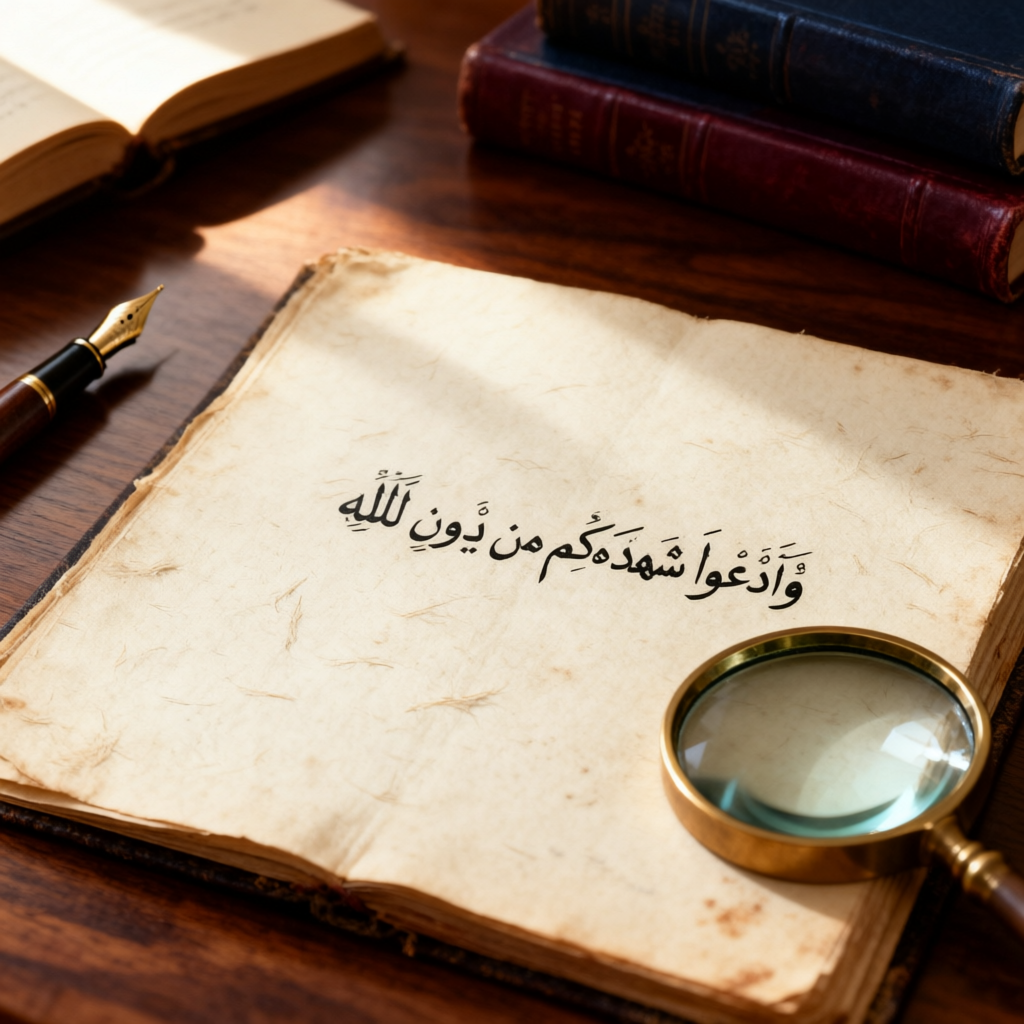
Grammatically, the Qur'an often violates standard Arabic word order for rhetorical effect, but never at the expense of clarity. For instance, in the phrase call upon your witnesses besides Allah (وَٱدْعُوا۟ شُهَدَآءَكُم مِّن دُونِ ٱللَّهِ), the prepositional phrase comes after the noun, focusing attention on witnesses. This structure is intentional and cannot be replicated without losing the nuance. The grammar is consistent and self-consistent across 114 surahs revealed over 23 years, with no linguistic contradictions.
Rhetorically, the Qur'an uses devices like chiasmus, parallelism, and embedded stories that are thematically interwoven. For example, the story of Moses appears in multiple surahs, each time highlighting a different lesson, yet the details never contradict. This kind of coherence across a large corpus is unprecedented in human literature. Known authors, even great ones, produce variations in style, vocabulary, and focus over a long career, but the Qur'an maintains a unified voice and thematic harmony.
When skeptics ask what are scientific errors in the Qur'an? or what scientific inaccuracies are in the Qur'an? they often assume that any ancient text must contain errors if it is claimed to be divine. But the Qur'an's descriptions of natural phenomena, such as embryology, the water cycle, and the expansion of the universe, have been shown to align with modern scientific discoveries. This is not a proof of divine origin in itself, but it is an evidential factor that must be considered alongside the linguistic challenge.
Testing the Hypotheses: Human Authorship vs. Divine Origin
When investigating the authorship of the Qur'an, one must consider all plausible explanations and weigh them against the evidence. The common skeptical hypothesis is that Muhammad wrote the Qur'an himself, or that it was a collaborative effort with others. Another hypothesis is that it was influenced by Judeo-Christian scriptures or Arabian oral traditions. A third is that it is a literary creation that evolved over time. And finally, the Qur'an's own claim, that it is a revelation from God, must be treated as a hypothesis to be tested, not a conclusion to be assumed.
To test the human authorship hypothesis, we must ask: is there any human who produced a comparable work in Arabic? The history of Arabic literature shows that pre-Islamic poetry, and later Islamic prose, have never achieved the same level of linguistic excellence and depth as the Qur'an. The challenge to produce a surah like it remains unanswered. The best-known attempt was by the poet Musaylimah, who claimed prophethood during Muhammad's lifetime and produced verses that the Arabs immediately recognized as inferior and laughable. His work survives in fragments and bears no resemblance to the Qur'an's style.
As for the borrowing hypothesis, the Qur'an itself anticipates this and says, And among them are those who listen to you, but We have placed over their hearts coverings, lest they understand it, and in their ears deafness. And if they should see every sign, they will not believe in it, to the point that when they come to you, they argue with you, and those who disbelieve say, 'This is nothing but legends of the former peoples' (Qur'an 6:25). The claim that the Qur'an is legends of the former peoples is directly addressed. If it were merely copied, one would expect clear anachronisms, narrative inconsistencies, or obvious dependence. Yet, when compared to biblical accounts, the Qur'an's versions often contain unique details, different emphases, and corrections of potential errors in the earlier texts.
For example, the Qur'an's account of Mary's birth and childhood (Qur'an 3:35-37) differs significantly from the canonical gospels. It includes details like Mary being dedicated to the temple and being provided for by God, which are not found in the Bible but have parallels in apocryphal literature. However, the Qur'an's versions are not mere reproductions; they are presented as original revelation that corrects and completes earlier scripture. The differences are as important as the similarities.
Finally, the divine origin hypothesis must be evaluated based on the Qur'an's own criteria: its internal consistency, its fulfillment of the challenge, and its absence of contradiction. The Qur'an claims multiple times that it is preserved from error. Do they not then reflect on the Qur'an?Had it been from other than Allah, they would surely have found therein much contradiction (Qur'an 4. 82). This invites a test. If any contradiction can be found, the claim is falsified. Skeptics have pointed to apparent contradictions, but each one, when examined in light of the Arabic and context, has been resolved. The Qur'an's coherence across its entire text, despite being revealed piecemeal over 23 years, is strong evidence against human fabrication.

Conclusion: What the Text Has Told Us
The question Who wrote the Qur'an? is not merely an academic exercise; it is the central question that determines how one views the entire Islamic tradition. By going back to the primary source, the Qur'an itself, we find a clear challenge: produce a surah like it, with all the help you can get. This challenge sets an objective, testable criterion. Over centuries, no one has succeeded. The linguistic analysis of the Arabic reveals a level of complexity, precision, and coherence that is unparalleled in human literature. These are observable facts.
At the same time, the Qur'an's own claims about its origin must be taken seriously. It claims to be the word of God, and it provides evidence for that claim. The evidence includes its literary excellence, its internal consistency, its harmony with scientific knowledge, and its moral and spiritual depth. None of these individually constitute proof, but together they form a cumulative case that aligns with the Qur'an's self-description.
Ultimately, the investigator must decide. The Qur'an does not force anyone to believe; it invites reflection. As it says, There is no compulsion in religion; right direction is clearly distinguished from error (Qur'an 2: 256). The text provides the evidence, and the reader is left to reach their own conclusion. This investigation has shown that the evidence, when examined honestly and rigorously, points to the Qur'an being what it claims. A revelation from the Creator, not the composition of a human being.

For those who still have questions to ask about the Qur'an, the platform Question the Quran provides the tools to go directly to the source. The Arabic text with word-by-word meanings is available for anyone to examine, without intermediaries. The Qur'an has already answered the question of its authorship, it is now up to each reader to see whether that answer is convincing.