The Six Days of Creation: Testing the Eight-Day Claim
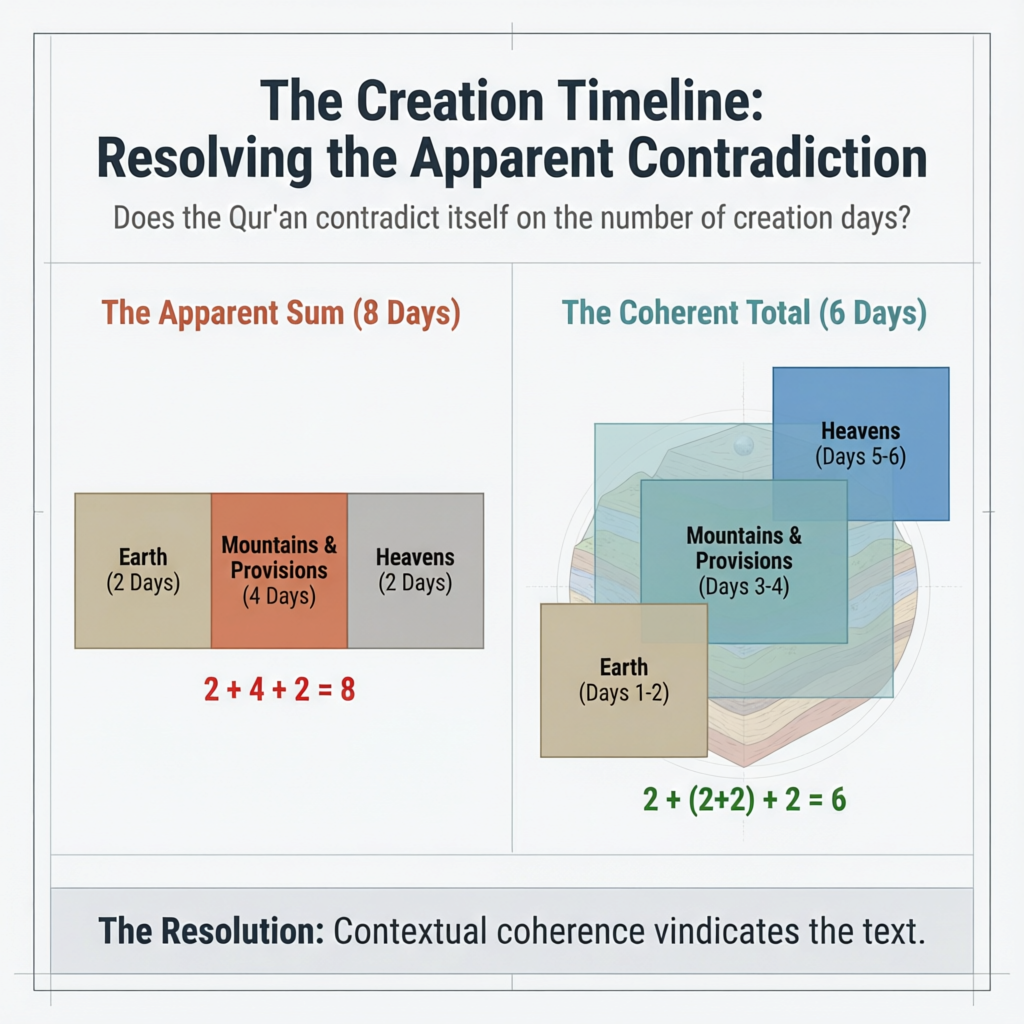
In this investigation, we open every verse that mentions the duration of creation, including 7: 54, 50. 38, and 41:9-12, and compare the Arabic wording.The claim under investigation can be stated precisely: the Qur'an says creation took six days in some verses, but a careful reading of 41. 9-12 yields eight, revealing a contradiction. This is a serious charge, often raised under the broader question of whether the Qur'an contains errors. Rather than respond with assertion, we will place the verses side by side and let the primary text speak.
Our method follows a simple rule: separate the literal Arabic from interpretation, and read every verse within its immediate context before drawing conclusions. The Qur'an itself insists on this discipline. In 4. 82, it asks: 'Do they not then consider the Qur'an with care? But if it had been from other than God, they would surely have found therein much discrepancy.' The Arabic word here is 'tadabbaru', to ponder, to trace something to its end. The text challenges us to examine it thoroughly, and we accept that challenge.
We will quote each verse in Arabic with a literal English rendering, then examine the key terms. Arabic is a precise language; much hinges on the exact form of a word, its root, and its grammatical function. A single letter can change the meaning entirely. The investigation must therefore begin with the Arabic text, not with translations that may smooth over or exaggerate distinctions.
No conclusion will be assumed at the start. We are not trying to prove the Qur'an right or wrong; we are trying to find what the text actually says. The evidence will determine the outcome. And if the evidence demonstrates the Qur'an is coherent, then that coherence becomes part of the larger question: is the Qur'an the word of God? But first, the verses.