The Claim: A Contradiction in the Quran's Description of God
Critics of the Quran often point to what appears to be a simple inconsistency: the text describes God's hands sometimes in the singular, sometimes in the dual, and sometimes in the plural. For example, verse 5:64 says 'nay, both His hands are outstretched,' using the dual form. Verse 48:10 says 'the hand of Allah is above their hands,' using the singular. And verse 36:71 says 'for them We have created... things which Our hands have made,' using the plural. To a reader unfamiliar with Arabic, this variation looks like a clear contradiction. How can God have one hand, two hands, and many hands at the same time?
The charge is that the Quran is inconsistent and therefore cannot be divinely authored. The assumption is that a single divine source would use a consistent grammatical form when referring to the same attribute. But this assumption overlooks a fundamental feature of Arabic: the language uses number not just to indicate quantity, but also to convey nuance, emphasis, and idiomatic meaning. In Arabic, the choice between singular, dual, and plural forms of a noun can carry different connotations that are not captured by a simple literal translation.

Before we jump to a conclusion, we need to apply the investigation methodology: examine the evidence first. That means looking at each verse in its original Arabic, understanding the root word, the grammatical form, and the context. The question is not whether the forms differ—they do—but whether the differences are logically contradictory or whether they serve distinct rhetorical and theological purposes. The Quran itself invites this kind of examination, repeatedly urging readers to reflect and to investigate its verses with care.
Let us begin by retrieving the verses directly from the verified Qur'an database, presenting the Arabic text and a literal translation, before any interpretation. We will then analyze each form in its context. The goal is not to defend a preconceived notion, but to let the evidence determine the conclusion. If a genuine contradiction exists, it should be demonstrable step by step. If it does not, the explanation should be equally clear.
Verse 5:64: The Dual Form – Both Hands Outstretched
The first verse often cited is Surah Al-Ma'idah, verse 64. The Arabic reads: 'بَلْ يَدَاهُ مَبْسُوطَتَانِ' – the key word is 'يَدَاهُ' (yadaahu). This is the dual form of the noun 'يَد' (yad, hand) attached to the pronoun 'هُ' (his). The dual in Arabic is a specific grammatical number used exclusively for exactly two items. So 'yadaahu' means 'his two hands.' The verse then says they are 'مَبْسُوطَتَانِ' (mabsuutataan), the dual feminine form of the passive participle, meaning 'outstretched' or 'spread open.' The full phrase is 'nay, both His hands are outstretched,' indicating an abundant, open-handed generosity.
Linguistically, the dual form here is precise and intentional. It is not arbitrary. In Arabic, when emphasizing that an action or attribute is complete and ample, the dual can be used idiomatically to convey a sense of fullness and sufficiency. It does not necessarily mean that God has exactly two physical hands as we understand them. Rather, it is a rhetorical device used to express the idea that God's giving is unlimited and that He is not withholding anything. The dual form 'both hands' is a known idiom in classical Arabic for abundance and complete capacity.
Contextually, 5:64 is addressing the Jews who said 'Allah's hand is chained up' – meaning He is stingy. The Quran responds emphatically: 'Their hands are chained up and they are cursed for what they said. Nay, both His hands are outstretched. He spends however He wills.' The dual form 'both hands' directly counters the accusation of stinginess by conveying that God's giving capacity is double-strength, as it were. It is not a numerical claim about the number of limbs, but a linguistic rebuttal emphasizing liberality. The contradiction claim begins to unravel when we recognize that the dual here is a rhetorical choice, not a theological statement of anatomy.
Furthermore, the Quran consistently uses anthropomorphic language about God in a way that Muslims understand as 'without how' (bila kayf). The Arabic linguistic tradition recognizes that attributes like 'hand' (yad) are to be affirmed as they appear, but their exact modality is not specified. The dual form does not create a contradiction because it is not a literal description of a physical body; it is a meaningful expression within the language. The question is not 'how many hands does God have?' but 'what is the intended meaning of each grammatical form?' The answer emerges as we compare the other verses.
Verse 48:10: The Singular Form – The Hand of Allah
The second verse is Surah Al-Fath, verse 10: 'إِنَّ الَّذِينَ يُبَايِعُونَكَ إِنَّمَا يُبَايِعُونَ اللَّهَ يَدُ اللَّهِ فَوْقَ أَيْدِيهِمْ' – 'Indeed, those who pledge allegiance to you, they are only pledging allegiance to Allah. The hand of Allah is above their hands.' The word for 'hand' here is 'يَدُ' (yadu), which is the singular form in the nominative case. It is not dual or plural. The verse uses the singular to refer to God's hand being 'above' the hands of those giving the pledge of allegiance.
Why the singular here? The context is the pledge of allegiance (bay'ah) given to the Prophet Muhammad at Hudaybiyyah. The Quran states that when people place their hands in the Prophet's hand to swear allegiance, they are actually placing their hands in God's hand. The singular form 'yad' is used to emphasize the unity and directness of the divine acceptance of the pledge. In Arabic, the singular can be used generically to refer to the 'hand' as a symbol of authority, power, or action, without focusing on number. It is similar to saying 'the government's hand is upon the situation' in English – we do not mean a literal hand, but authority and control.
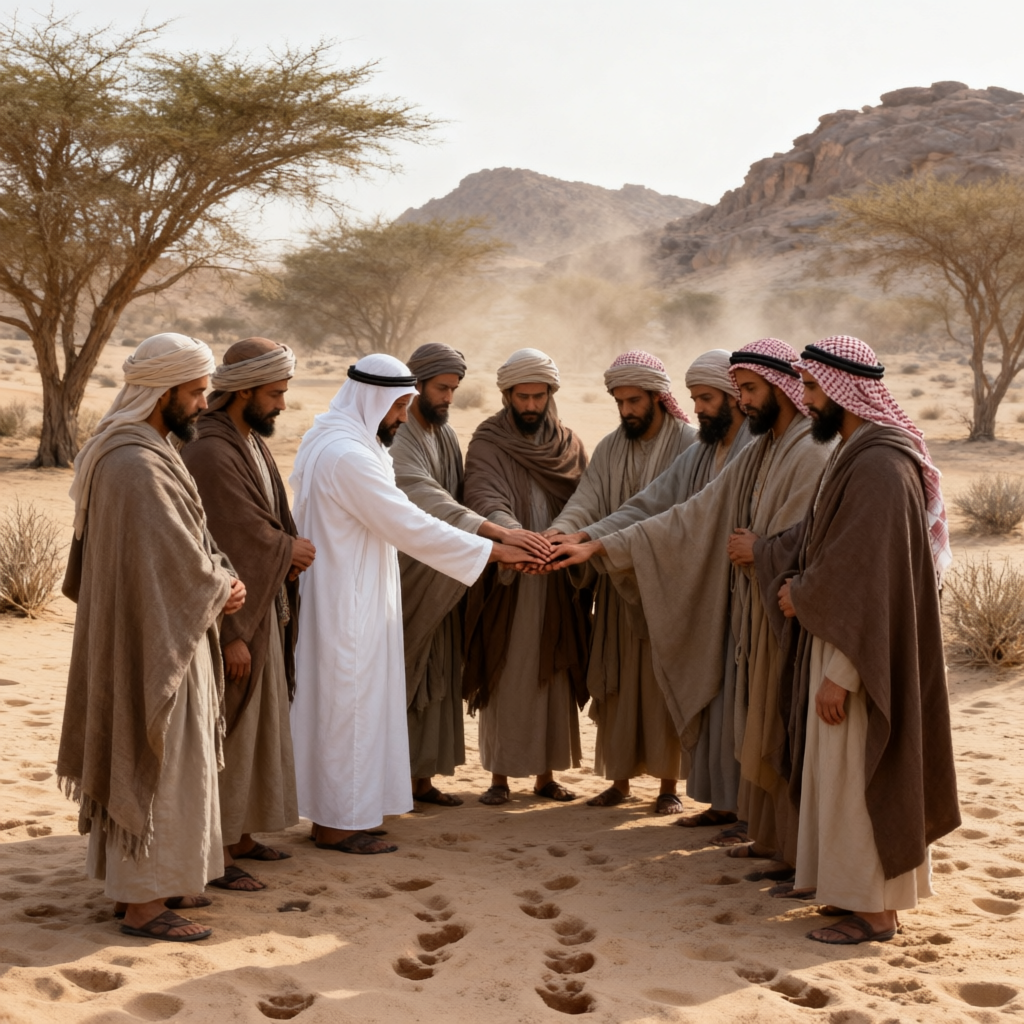
The singular is also appropriate here because the image is one of a single hand covering or being above many hands. The pledge involves many individual hands reaching out, but the divine response is depicted as a single overarching hand of authority that encompasses them all. This is not a contradiction with the dual in 5:64; it is a different context requiring a different nuance. The dual in 5:64 emphasized abundance; the singular in 48:10 emphasizes direct authority and oversight.
Linguistically, Arabic commonly uses the singular for abstract concepts like 'power,' 'authority,' or 'control.' For example, 'يد الدولة' (yad al-dawlah) means 'the hand of the state' – a singular noun referring to the government's control, not a literal number of limbs. So the singular 'yad Allah' in 48:10 is perfectly consistent with idiomatic Arabic. It does not assert that God has only one hand; it uses the singular to denote the concept of divine authority. The critical error is to treat these different grammatical forms as if they were literal anatomical descriptions, when in fact they are rhetorical and idiomatic. The investigation of the Arabic root and its contextual usage resolves the apparent contradiction.
Verse 36:71: The Plural Form – Our Hands Have Made
The third verse is Surah Ya-Sin, verse 71: 'أَوَلَمْ يَرَوْا أَنَّا خَلَقْنَا لَهُم مِّمَّا عَمِلَتْ أَيْدِينَا أَنْعَامًا' – 'Do they not see that We have created for them, from what Our hands have made, cattle?' The word for 'hands' here is 'أَيْدِينَا' (aydinaa), which is the plural form of 'yad' attached to the pronoun 'na' (Our). The plural 'aydin' is used, often translated as 'hands' but understood in Arabic as a plural of majesty or intensification. In classical Arabic, the plural can be used for a single entity to denote greatness, power, or an abundance of action.
This usage is known as the 'plural of respect' or 'plural of majesty' (jam' al-'azamah). It is commonly employed in the Quran when God speaks of Himself using 'We' (nahnu) and related forms. For instance, when God says 'We created' (khalaqnaa), it is a royal 'We' indicating divine majesty, not a literal plurality of persons. Similarly, 'Our hands' (aydinaa) uses the plural to convey that the creation of cattle was an act of supreme power and artistry, not that God has multiple limbs. The plural form here intensifies the sense of direct divine craftsmanship.

Contextually, 36:71 is part of a larger argument in Surah Ya-Sin that calls people to recognize God's power and provision. The verse points to domesticated cattle as a sign of God's creative favor: He created them with His own hands, as it were, implying care and mastery. The plural 'aydinaa' matches the majestic plural used throughout the verse ('We have created') and throughout the Quran for divine actions. It would be inconsistent to use the singular or dual here because the whole passage uses the plural of majesty for God. The choice is grammatically coherent with the style of the surah.
Thus, the plural in 36:71 is not a claim about multiple hands; it is a linguistic feature of majestic speech. When we compare the three verses, we see a consistent pattern: each form (singular, dual, plural) is chosen for its rhetorical and contextual appropriateness. The singular emphasizes authority in a pledge, the dual emphasizes abundance in response to stinginess, and the plural emphasizes majesty in creation. There is no contradiction because the underlying concept – that God acts directly and with full power – is unified. The different numbers are simply different ways of expressing that concept in different contexts, exactly as Arabic allows.
Why the Apparent Contradiction Disappears Under Investigation
The key to resolving this issue lies in understanding that Arabic, like many languages, uses grammatical number to convey meaning beyond mere quantity. In English, we have remnants of this: we say 'the government is' (singular) even though a government consists of many people. We say 'the committee are divided' (plural) when we want to emphasize the individuals. Number often serves a rhetorical function. In Arabic, this is even more developed. The dual is used for pairs and also for emphasis (as in 'both hands' to mean abundant giving). The plural is used for more than two and also for majesty or intensification. The singular is used for one and also for generic concepts.
When critics see 'yad' (singular) in one verse and 'yadaan' (dual) in another and 'aydin' (plural) in a third, they assume a literal contradiction because they are reading English translations that treat these as simply 'hand,' 'two hands,' and 'hands.' But the original Arabic reader would have understood the nuances immediately. The consistency is not in the form but in the function: all three verses affirm that God acts directly and with full power. The specific form is tailored to the context. The investigation shows that the Quran is not contradicting itself; it is using the richness of Arabic to communicate precise shades of meaning.
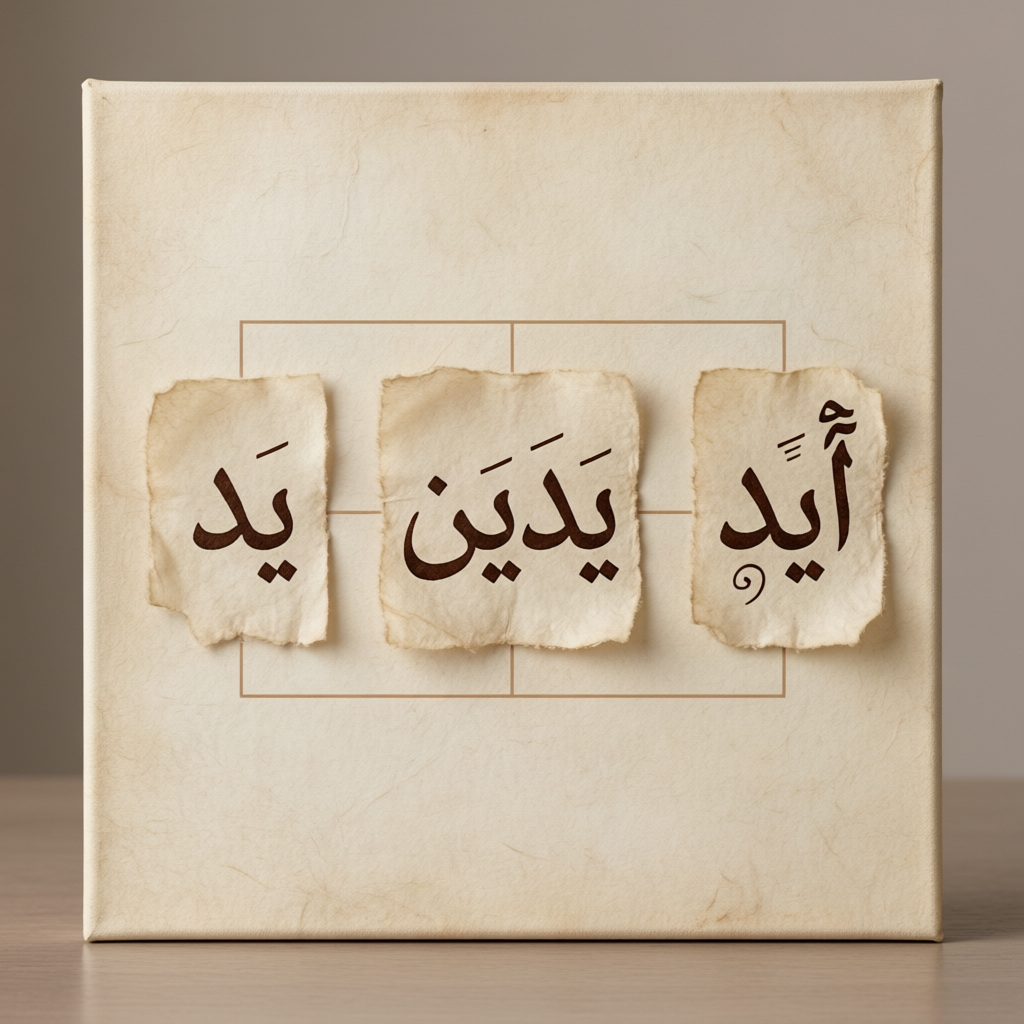
Moreover, the charge of contradiction fails the standard of step-by-step demonstration. To claim a contradiction, you must show that the verses make incompatible truth claims. But what incompatible claims do they make? 5:64 says God's hands are outstretched (dual) – that is a statement of generosity. 48:10 says God's hand is above theirs (singular) – that is a statement of authority. 36:71 says God's hands made cattle (plural) – that is a statement of creative power. These are not contradictory; they are complementary. They describe different aspects of divine action using the appropriate grammatical tools. There is no logical inconsistency.
Finally, we must recall the investigation principle: if multiple plausible explanations exist, all must be considered before jumping to the conclusion of error. The explanation that the Quran is inconsistent because of varying grammatical numbers is only one hypothesis. The alternative explanation – that the Quran deliberately uses different forms for specific rhetorical purposes – is supported by the evidence of Arabic grammar and context. Which explanation requires fewer unsupported assumptions? The contradiction hypothesis assumes that the author did not know how to use Arabic consistently, which contradicts the eloquent and sophisticated language of the Quran. The rhetorical explanation requires no such assumption; it fits seamlessly with known linguistic features of Arabic. The evidence points to consistency, not contradiction.
Conclusion: The Quran's Internal Coherence on Divine Attributes
After investigating the three verses in their original Arabic, we can conclude that the alleged contradiction about God's hands is not supported by the evidence. The Quran uses the singular, dual, and plural forms of 'yad' in a linguistically consistent and rhetorically effective manner. Each form serves a distinct purpose within its context, communicating nuances of authority, abundance, and majesty. There is no logical clash; rather, there is a coherent pattern of divine self-expression through the richness of the Arabic language.
This investigation underscores a broader principle: when approaching the Quran, one must go beyond superficial readings and translations. The text rewards careful study of its language, grammar, and context. Apparent contradictions often dissolve when the evidence is examined with rigor. The Quran itself invites this kind of investigation, and it consistently vindicates itself to those who approach it honestly.

For the reader who encounters such criticisms, the path forward is clear: go to the primary source. Examine the Arabic. Consult lexical authorities. Understand the context. Do not rely on second-hand claims or oversimplified translations. The Quran is its own best evidence, and when it speaks of the hands of God, it does so with precision and consistency. The choice to believe or not remains yours, but the evidence is on the table.