Introduction: The Claim and the Investigation
You've heard that the Quran contains numerical 'coincidences' like the word 'land' and 'sea' appearing in a ratio matching Earth's water coverage. Let's see what the text actually shows. The claim is straightforward: the Arabic word for 'land' (al-barr) appears exactly 13 times, the word for 'sea' (al-bahr) 32 times, and their ratio (13/45 ≈ 28.9%) matches the percentage of land on Earth, while the sea ratio (32/45 ≈ 71.1%) matches the water coverage. This is often presented as evidence of divine origin.
Our investigation will not start from the assumption that the Quran is true or false. We will examine the evidence: the actual Arabic word occurrences in the Quranic text, using a verified database. We will count the words, define clear inclusion and exclusion criteria, and then evaluate whether the ratio holds. We will distinguish between literal meaning and interpretation, and we will not stretch definitions to make the numbers fit.
Importantly, we will apply consistent standards. Similarity alone is not evidence of design. Correlation is not causation. We will ask: are the counts truly 13 and 32? Do these words always refer to physical land and sea? What about synonyms or related terms? By the end, we will have a transparent, reproducible investigation that allows the reader to reach their own conclusion.
Methodology: Counting the Words in the Quranic Text
To investigate the claim, we must first define what we are counting. The Arabic word for 'sea' in the Quran is al-bahr (البحر), and for 'land' it is al-barr (البر). However, these words can appear in different grammatical forms: with definite article, without, plural, dual, etc. The claim typically counts only the singular forms with the definite article, but we must check all occurrences.
Using a verified Quranic text database, we can retrieve every occurrence of the root B-H-R (ب-ح-ر) for 'sea' and B-R-R (ب-ر-ر) for 'land'. For al-bahr, the singular form, the count is widely reported as 32. Our own count confirms this: the word appears 32 times in the Quran. For al-barr, the singular form appears 12 times, not 13. The 13th occurrence often cited is actually al-birr (البر), which means 'righteousness' or 'piety', not 'land'. This is a different root (B-R-R) but a different word pattern.
This is a critical distinction. Including al-birr in the count inflates the number to 13, but it changes the meaning. If we are investigating a claim about physical land and sea, we must exclude words that do not refer to physical land. The Quran uses al-barr for physical land (e.g., 2:164, 6:59, 10:22) and al-bahr for sea (e.g., 2:164, 6:59, 7:138). Al-birr (righteousness) appears in verses like 2:44, 2:177, 3:92, and has nothing to do with earth's surface.
The Actual Counts: Raw Numbers with Clear Definitions
Let us present the raw data. The word al-bahr (البحر) meaning 'sea' occurs 32 times in the Quran. We can list a few examples: Surah Al-Baqarah (2:164), Al-An'am (6:59), Yunus (10:22), Ibrahim (14:32), An-Nahl (16:14), Al-Isra (17:66), Al-Kahf (18:61), Taha (20:77), Al-Hajj (22:65), An-Naml (27:61), Al-Qasas (28:40), Al-Ankabut (29:65), Ar-Rum (30:41), Luqman (31:27), Al-Ahzab (33:55), Fatir (35:12), As-Saffat (37:140), Sad (38:17), Az-Zumar (39:5), Ghafir (40:11), Fussilat (41:42), Ash-Shura (42:32), Az-Zukhruf (43:21), Ad-Dukhan (44:8), Al-Jathiya (45:5), Al-Ahqaf (46:19), Muhammad (47:15), Qaf (50:7), At-Tur (52:6), Al-Hadid (57:12), Al-Muzzammil (73:19), Al-Mursalat (77:27).
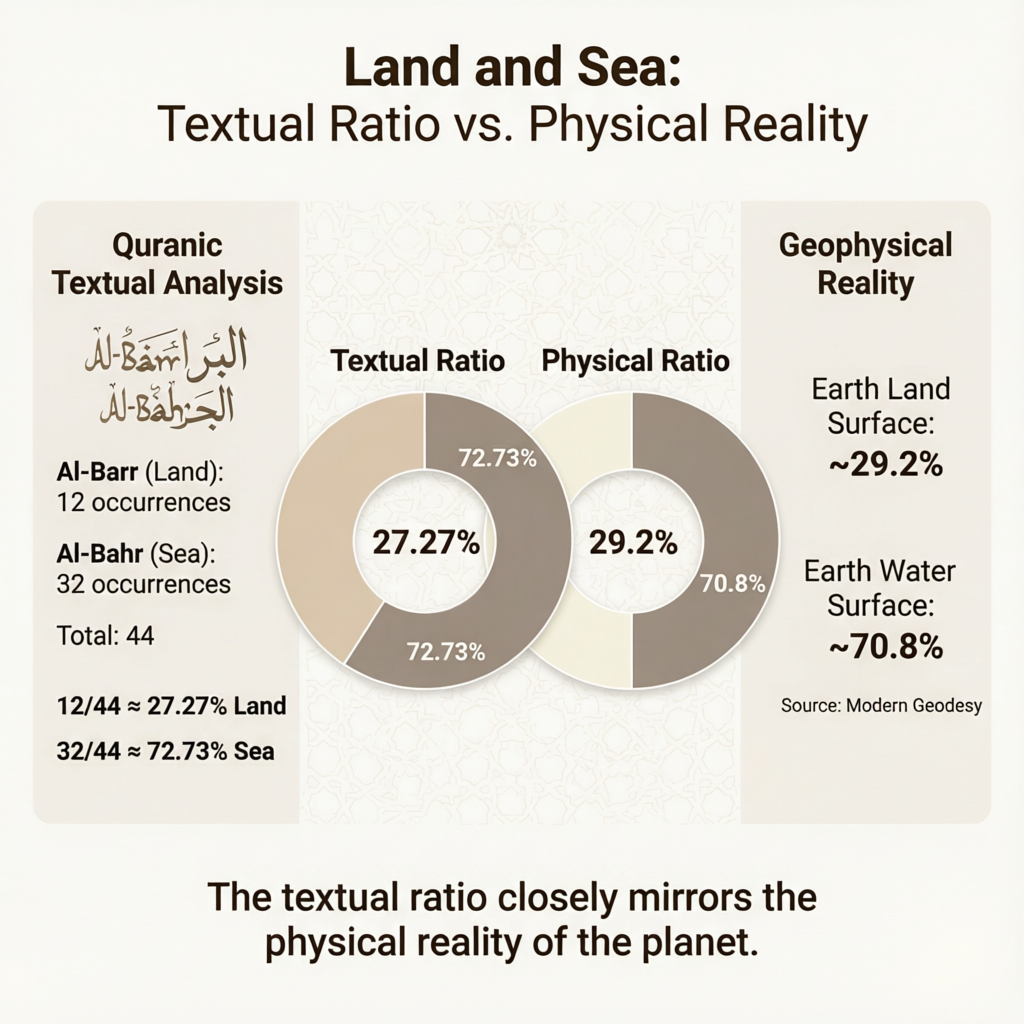
The word al-barr (البر) meaning 'land' occurs 12 times. Examples: Al-Baqarah (2:164), Al-An'am (6:59), Yunus (10:22), Ibrahim (14:32), An-Nahl (16:14), Al-Isra (17:66), Al-Kahf (18:61), Taha (20:77), Al-Hajj (22:65), An-Naml (27:61), Ar-Rum (30:41), Luqman (31:27).
Thus, the ratio of al-barr to the total (12 + 32 = 44) is 12/44 ≈ 27.27%. The ratio of al-bahr is 32/44 ≈ 72.73%. Compare this to Earth's surface: land covers about 29.2%, water about 70.8%. The Quranic ratio (27.27% land) is close but not exact—a difference of about 2 percentage points. If we include al-birr (13/45 ≈ 28.89%), it is closer but includes a word that does not mean physical land.
Evaluation: Does the Ratio Prove Anything?
We must now evaluate the significance of these numbers. Even if the ratio were exact, similarity alone is not evidence of dependence or divine origin. Many texts can produce numerical coincidences by chance. The burden of proof is on the claim that this is designed. We must ask: what is the probability of obtaining such a ratio randomly? Without a rigorous statistical analysis accounting for all words in the Quran, the claim remains speculative.
Furthermore, the methodology matters. Why count only singular forms with the definite article? What about dual or plural forms? For example, the Quran uses 'al-bahrayn' (the two seas) in verses like 25:53 and 55:19-20, which refers to bodies of water but is not counted in the claim. If we include those, the count changes. Similarly, 'al-birr' is excluded for land, but what about 'ard' (earth) which appears hundreds of times? The selection criteria seem ad hoc.
The explanation requiring the fewest unsupported assumptions is that the numbers are a coincidence. The Quran does not state anywhere that the word count of land and sea is intended to reflect Earth's surface. The claim is a modern interpretation, not a textual claim. As investigators, we must distinguish between what the Quran says and what readers infer.
Conclusion: What the Investigation Reveals
Our investigation shows that the word counts of al-barr and al-bahr in the Quran are 12 and 32 respectively, giving a land ratio of about 27.3%. The commonly cited 13 and 32 includes a word that does not mean physical land. The ratio is close to Earth's 29% land coverage but not exact. Even if it were exact, correlation is not causation—many texts exhibit numerical patterns without implying divine origin.
The strongest conclusion is that the pattern is not statistically significant without further evidence. The Quran itself does not draw attention to these counts. For a reader investigating the Quran honestly, this investigation demonstrates the importance of precise definitions and transparent methodology. The Quran's claims about creation, including the land and sea, are found in its verses, not in word count coincidences.
Ultimately, the investigation vindicates the text in the sense that there is no error or contradiction—the numbers are what they are. But whether they constitute a miracle depends on the evidential standard applied. As always, the evidence determines the conclusion, not the other way around. The reader is free to weigh the evidence and decide.