What Are the Seven Ahruf? Tracing the Claim to Its Sources
The claim that the Quran was revealed in seven ahruf (أحرف) originates primarily from hadith literature, not from the Quran itself. The most widely cited hadith, found in Sahih al-Bukhari and Sahih Muslim, reports that the Prophet Muhammad said the Quran was revealed in seven ahruf, and that reciting according to any of them is acceptable. But what exactly does ahruf mean? The Arabic word حرف (harf) can mean 'letter,' 'edge,' 'mode,' or 'way.' In this context, scholars have debated whether it refers to dialectal variations, different wordings, or something else entirely. To investigate properly, we must first distinguish between the Quranic text and the secondary reports about it. The Quran itself does not use the term ahruf in this way. It does, however, speak about its own recitation and preservation.
What the Quran Says About Its Own Recitation
The Quran contains several verses that instruct the Prophet on how to recite. For example, in Surah Al-Muzzammil (73:4), Allah commands: وَرَتِّلِ الْقُرْآنَ تَرْتِيلًا — 'and recite the Quran with measured recitation.' The word ترتيل (tarteel) implies a slow, deliberate, and clear recitation, not multiple variant forms. In Surah Al-Qiyamah (75:16-18), Allah instructs: لَا تُحَرِّكْ بِهِ لِسَانَكَ لِتَعْجَلَ بِهِ — 'Move not your tongue with it to hasten it. Indeed, upon Us is its collection and its recitation.' These verses emphasize careful, precise transmission. The Quran also claims in Surah Al-Hijr (15:9): إِنَّا نَحْنُ نَزَّلْنَا الذِّكْرَ وَإِنَّا لَهُ لَحَافِظُونَ — 'Indeed, it is We who sent down the message, and indeed, We will be its guardian.' This divine guarantee of preservation suggests that the text was protected from corruption, including through variant readings that could alter meaning.

Historical Evidence for the Seven Ahruf: Hadith and Manuscripts
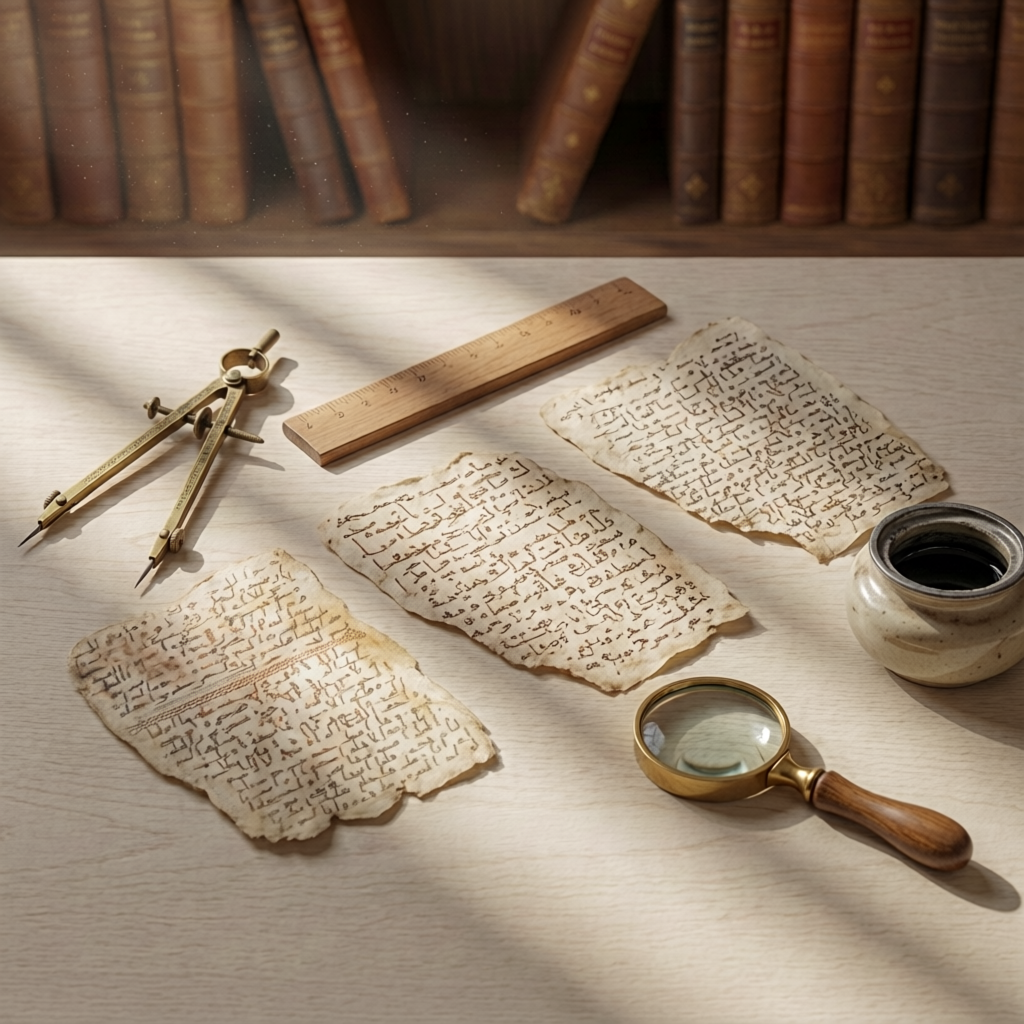
The hadith literature provides the primary evidence for the seven ahruf. In Sahih al-Bukhari, a hadith states that the Quran was revealed in seven ahruf to make it easy for the community. However, the hadith also records that during the caliphate of Uthman, the Quran was standardized into a single textual format (the Uthmanic codex), and all other versions were ordered to be burned. This suggests that whatever the seven ahruf were, they were not intended to remain as independent textual traditions indefinitely. The oldest Quranic manuscripts, such as the Birmingham Quran (dating to the 7th century), show a text that is remarkably consistent with the standard text used today. They contain minor orthographic variations—differences in spelling or letter shapes—but no substantial differences in words or meanings. This manuscript evidence indicates that the Quran was transmitted with high fidelity from an early period.
The Relationship Between Ahruf and Qira'at: Clarifying Terminology
A common confusion is equating the seven ahruf with the ten qira'at (قراءات) or the seven canonical readings. The qira'at are systematic methods of recitation that developed later, in the 2nd and 3rd centuries after Hijra. These readings involve differences in vowelization, dotting, and sometimes word forms, but they all rely on the same Uthmanic consonantal skeleton (rasm). For example, in Surah Al-Fatiha (1:4), the word مَالِكِ (maliki, 'owner') is also read as مَلِكِ (maliki, 'king') depending on the qira'ah. Both forms are attested in early manuscripts as possible readings of the undotted rasm. The qira'at do not represent different revelations but different legitimate ways of pronouncing the same written text. The seven ahruf, whatever they were, likely preceded and were partly absorbed into the qira'at system.
Investigating Whether the Ahruf Affect the Quran's Preservation Today
The key question for any investigator is whether the existence of multiple ahruf undermines the claim that the Quran is preserved exactly as revealed. To answer this, we must examine whether the differences between the canonical readings affect meaning or introduce contradictions. In practice, the differences are minor and do not change the core message. For instance, the reading in Surah Al-Baqarah (2:125) of فَتَحَ (fataha, 'opened') versus فَتُحَ (futuha, 'were opened') yields the same conceptual meaning. Scholars who have compared the qira'at conclude that they are mutually consistent and do not produce theological discrepancies. The Quran itself invites scrutiny in Surah An-Nisa (4:82): أَفَلَا يَتَدَبَّرُونَ الْقُرْآنَ ۚ وَلَوْ كَانَ مِنْ عِنْدِ غَيْرِ اللَّهِ لَوَجَدُوا فِيهِ اخْتِلَافًا كَثِيرًا — 'Then do they not reflect upon the Quran? If it had been from other than Allah, they would have found within it much contradiction.' The fact that the variant readings do not produce contradictions is consistent with the Quran's own claim.
Conclusion: What the Evidence Shows About the Seven Ahruf
After examining the evidence from the Quran itself, hadith, and manuscripts, a coherent picture emerges. The seven ahruf were likely a temporary concession allowing dialectal flexibility in the early Muslim community, but the divine guarantee of preservation ensured that the essential text remained unchanged. The standardization under Uthman eliminated any variants that could have led to disagreement, while the qira'at preserve legitimate phonological variations that do not alter meaning. The Quranic verses on recitation emphasize precision and care, aligning with the meticulous transmission we observe historically. For the investigator, the seven ahruf claim does not weaken the case for the Quran's preservation; rather, it demonstrates how the text was protected through a dynamic process. The bottom line is that the Quran we have today is the same revelation received by the Prophet, transmitted with the fidelity that its own verses promise. Evidence, not speculation, leads to this conclusion.