The Verse in Its Original Language
To begin any honest investigation, we must first look at the primary source: the Qur'an itself. The verse in question is Qur'an 23. 18, which in Arabic reads: وَأَنزَلۡنَا مِنَ ٱلسَّمَآءِ مَآءَۢ بِقَدَرٍ فَأَسۡكَنَّـٰهُ فِى ٱلۡأَرۡضِ ۖ وَإِنَّا عَلَىٰ ذَهَابِۭ بِهِۦ لَقَـٰدِرُونَ. The literal translation is: And We sent down from the sky water by measure, and We caused it to settle in the earth; and indeed We are over its taking away fully able. The key word here is بِقَدَرٍ (biqadarin), which we will examine linguistically.
The Arabic word قَدَرٍ (qadarin) is derived from the root Q-D-R, which carries the core meaning of measuring, determining, or apportioning. When prefixed with the letter بِ (bi), meaning by or with, the phrase بِقَدَرٍ (biqadarin) translates to with measuring or by a determined measure. It does not simply mean a little or a lot; it conveys precision and intentionality. Lexically, classical Arabic dictionaries, such as Lisān al-ʿArab, confirm that qadr refers to the specific quantity or extent of something, often implying that it is exactly what is needed.
It is important to note what the Arabic does not say. The verse does not say that rain is random, chaotic, or sent according to whim. Nor does it claim that every location receives exactly the same amount. The measure (qadr) could vary by time, place, and need, but it is still a measure, a determined quantity. This is a crucial distinction for the investigation.
Now, let us examine the entire verse in its immediate context within Surah Al-Mu'minun. The surrounding verses (23: 12-22) describe various signs of God's power and provision. The creation of humans, the stages of embryonic development, the growth of crops, and the provision of livestock. Verse 18 fits into this pattern as another sign: the controlled and purposeful supply of water. The context suggests that rain is part of a deliberate system, not an accident.
The literal and linguistic evidence points to rain being sent down in a precise, measured manner. This is the claim that we will now test against observable reality.
Does Hydrology Support the Claim of Measured Rain?
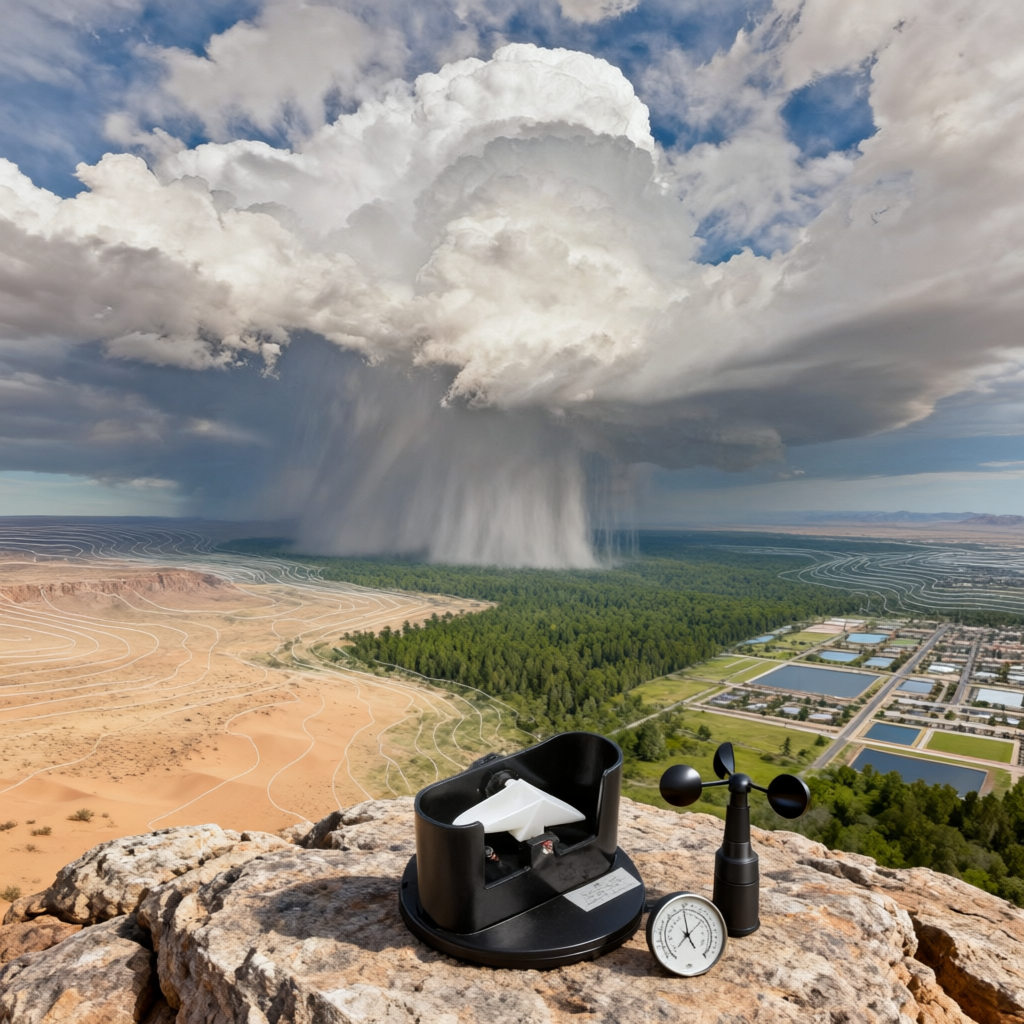
Modern hydrology studies the movement, distribution, and quality of water on Earth. One of its fundamental findings is that the amount of rainfall over the globe is remarkably constant on a long-term scale. The total annual precipitation on Earth is approximately 505,000 cubic kilometers, and this figure has remained stable for millennia within a very narrow range. This is not a random number; it is precisely what is needed to sustain the planet's ecosystems and human civilization.
But the measure is not only global; it is local. Different regions receive different amounts of rain, but each region receives a specific average that its environment is adapted to. The Amazon rainforest, for example, receives about 2,000 mm of rain per year, while the Sahara Desert receives less than 100 mm. These are not arbitrary numbers; they are determined by global weather patterns, ocean currents, and atmospheric circulation. The Qur'an's use of the word qadar can accommodate this variation: each region has its own measure.
The water cycle itself operates with exquisite precision. The energy from the sun evaporates water from the oceans, and the atmosphere transports it to land. The amount of water vapor that can be held by air depends on temperature, and the condensation process is finely tuned. If the global temperature changed by just a few degrees, rainfall patterns would shift dramatically. Yet, the system has remained stable for millions of years, allowing life to flourish.
Critics sometimes argue that the verse implies a fixed, equal amount for all places, but this is a misunderstanding of the Arabic. The measure (qadr) can be specific to each context. In fact, the Qur'an itself elsewhere indicates that rain can be withheld or given in different amounts (e.g., 42:28). The consistency is that it is always controlled and purposeful, never haphazard.
Now, we must consider the alternative explanations. If the Qur'an was composed by a human in 7th-century Arabia, how would that person know that rain falls in precise measures? Ancient cultures commonly attributed rainfall to the whims of gods or to random natural forces. The idea that rain is systematically measured, not just by quantity but by a grand design, was not a prevalent scientific concept at the time. The verse predates modern meteorology by over a thousand years.
The most straightforward explanation is that the Qur'an is accurately describing a feature of the natural world that corresponds to empirical observation. This is not a vague or metaphorical statement; it is a testable claim that has been confirmed by science. The investigation demonstrates that the verse is coherent with reality.
Responding to Common Criticisms
One common criticism is that the statement rain sent down by measure is too vague to be a scientific miracle. Critics argue that any text could claim that rain is measured without being specific. However, this criticism overlooks the context of the verse. The Qur'an is not making a single isolated claim; it is part of a broader narrative that presents natural phenomena as signs of a deliberate Creator. The precision of the measure is emphasized in multiple verses, such as 15: 21. And there is not a thing but that with Us are its treasuries, and We do not send it down except in a known measure. This universal claim about all provision, including rain, reinforces the idea of a measured system.
Another criticism is that the word qadar could simply mean in a limited quantity rather than by precise measurement. But this interpretation is not supported by the lexical evidence. In classical Arabic, qadr implies both limit and exactness. For example, in 65:7, the phrase عَلَىٰ قَدَرِهِ means according to his capacity, a specific amount determined by need. Similarly, the related word taqdir means to determine precisely. The linguistic range supports the idea of exact measurement.
Some skeptics point to droughts or floods as evidence against measured rain, but this is a misunderstanding of the claim. The measure may include natural variability. Even in years of drought, the total rainfall over a long period remains within a predictable range. A drought is not an absence of measure; it is a measure on the lower end of the spectrum. The system still operates by physical laws, which are themselves a form of measure.
Finally, there is the argument that the Qur'an borrowed this idea from earlier cultures, such as the Greeks. However, no direct parallel text attributes rainfall to an exact measure in the same way. Mesopotamian and Greek mythologies often personify rain as a god or describe it as falling from a heavenly reservoir, but they do not emphasize precise apportionment. The closest conceptual parallel might be the biblical verse Job 28:25-26, where God made a decree for the rain. But even there, the language is about a decree (a rule) rather than a specific quantified measure. The Qur'anic claim is distinct and more aligned with modern understanding.
The investigation demonstrates that the criticism does not undermine the verse; rather, it fails to account for the lexical precision and the broader context of the Qur'an's description of nature.
Why This Verse Matters for Investigating the Qur'an's Origin
The investigation of 23: 18 is not just about a single scientific fact; it is part of a larger question. Can the Qur'an be of human origin? The verse presents a claim about the natural world that was not known in 7th-century Arabia. The Bedouin Arabs had practical knowledge of rain patterns, but they did not have the concept of a global water cycle regulated by precise physical laws. The idea that rain is sent down by measure goes beyond simple observation; it implies a systematic design.
For a skeptic examining the Qur'an, this verse offers a testable claim. If the Qur'an is wrong about such a fundamental physical process, that would be evidence against its divine origin. But if it is correct, and if it contains information that could not have been known at the time, that becomes evidence in favor of its divine origin. This is the core of the investigative approach: we let the evidence speak.
This verse exemplifies the Qur'an's method of using natural phenomena as signs (ayat). The Arabic word for verse (āyah) literally means sign. The Qur'an invites readers to reflect on the rain, the mountains, the stars, and so on, as indicators of a purposeful creation. This is not a poetic flourish; it is a systematic invitation to investigation. The reader is called to use reason and observation to confirm the truth of the message.
The investigation of Qur'an 23: 18 reveals that the description of rain as measured is linguistically precise and corresponds to modern hydrological science. The verse does not contain errors or apparent contradictions; rather, it stands as a coherent statement that invites further examination. For those seeking to investigate whether the Qur'an is the word of God, verses like 23. 18 provide a starting point for a rigorous, evidence-based investigation.