Introduction: The Verse That Sparks Debate
Skeptics sometimes claim that the Qur'an contains scientific inaccuracies, pointing to specific verses that seem to conflict with modern knowledge. At the same time, some proponents argue that the Qur'an miraculously describes modern scientific discoveries long before they were known. One verse that appears in both discussions is Surah Adh-Dhariyat (51:47), which reads. And the heaven We constructed with strength, and indeed, We are [its] expander. The word expander translates the Arabic word 'musi'un', which has become central to claims about cosmic expansion.
Before jumping to conclusions on either side, it is essential to investigate the verse on its own terms. The Qur'an presents itself as a source of guidance, not a textbook of science, but it often contains statements that invite reflection on the natural world. The question is not whether the Qur'an agrees with modern physics, but rather what the Arabic text actually communicates. Only then can we evaluate whether a claim of scientific error or miraculous prediction is justified.
This investigation will proceed step by step. First, we examine the Arabic text of 51:47, its grammar, and the lexical range of 'musi'un'. Second, we consider what modern cosmology says about cosmic expansion. Finally, we compare the two, distinguishing between literal meaning, linguistic possibilities, and scientific claims. The goal is not to prove or disprove anything, but to investigate honestly.
By the end, you will have the evidence needed to decide for yourself. The Qur'an does not require blind acceptance; it repeatedly calls on readers to reflect and use reason. Let us do exactly that.
The Arabic of 51:47. What Does 'Musi'un' Actually Mean?
The full verse in Arabic is: وَالسَّمَاءَ بَنَيْنَاهَا بِأَيْدٍ وَإِنَّا لَمُوسِعُونَ. A straightforward translation is. And the heaven We built with strength, and indeed, We are [its] expander. The key word is 'lamusi'un' (لَمُوسِعُونَ), which is a plural form derived from the root w-s-' (و س ع), conveying the meaning of breadth, capacity, or expansion. Lexically, 'awsa'a' (أَوْسَعَ) means to make wide, to expand, to have ample space.
In classical Arabic, the word 'musi'un' can describe someone who is able to provide ample space, to extend, or to be expansive. It does not necessarily imply ongoing expansion in the modern physical sense; it can simply describe a state of possessing capacity or amplitude. For example, a generous person can be called 'musi' (موسع) because he has ample means. The verse's structure, 'inna la-musi'un' (إِنَّا لَمُوسِعُونَ), emphasizes the subject: We indeed are expansive/expanders.
Importantly, the verse does not use a verb (e.g., 'nawassi'u' نُوَسِّعُ, We are expanding) but a noun/adjective derived from the form IV verb. This static or substantive form can describe a quality or attribute rather than a dynamic process. Some scholars, such as Ibn Kathir, interpret 'musi'un' here as meaning We have made it vast or We possess the power to expand it. This is consistent with the idea of God's omnipotence and the heavens' capacity.
Also, the Arabic does not explicitly demand a continuous expansion like that described by modern cosmology. It affirms that God is the One who creates space and vastness. Without imposing modern scientific categories, the verse conveys that the heavens are not confined but rather are made with amplitude. This is the lexical and contextual reality before any scientific overlay.
What Does Modern Cosmology Actually Say About Expansion?
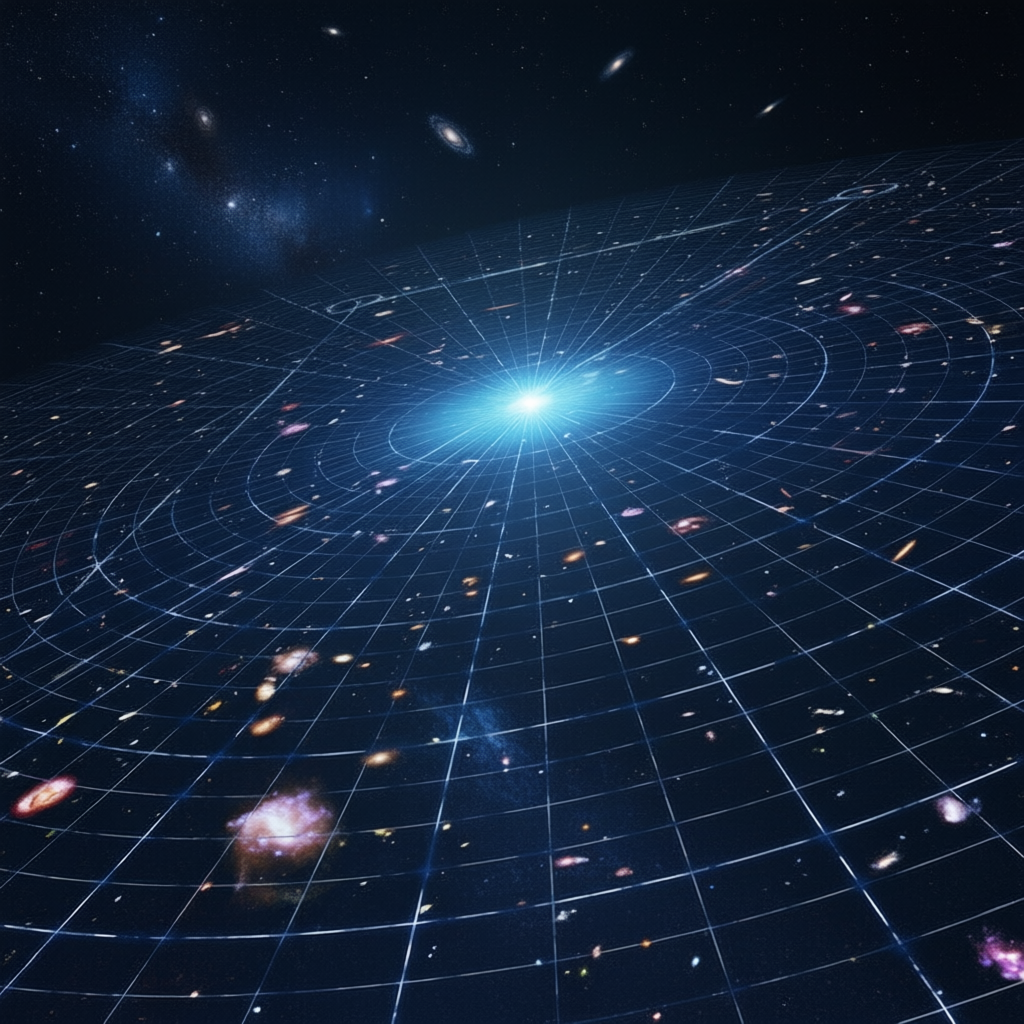
Modern cosmology, based on over a century of observational evidence, describes cosmic expansion as the increasing distance between galaxies over time. This was first observed by Edwin Hubble in 1929, who noted that galaxies appear to be moving away from us, with more distant galaxies receding faster. This led to the theory of the expanding universe, which is a cornerstone of the Big Bang model. The expansion is not a movement of galaxies through space, but rather the stretching of space itself between them.
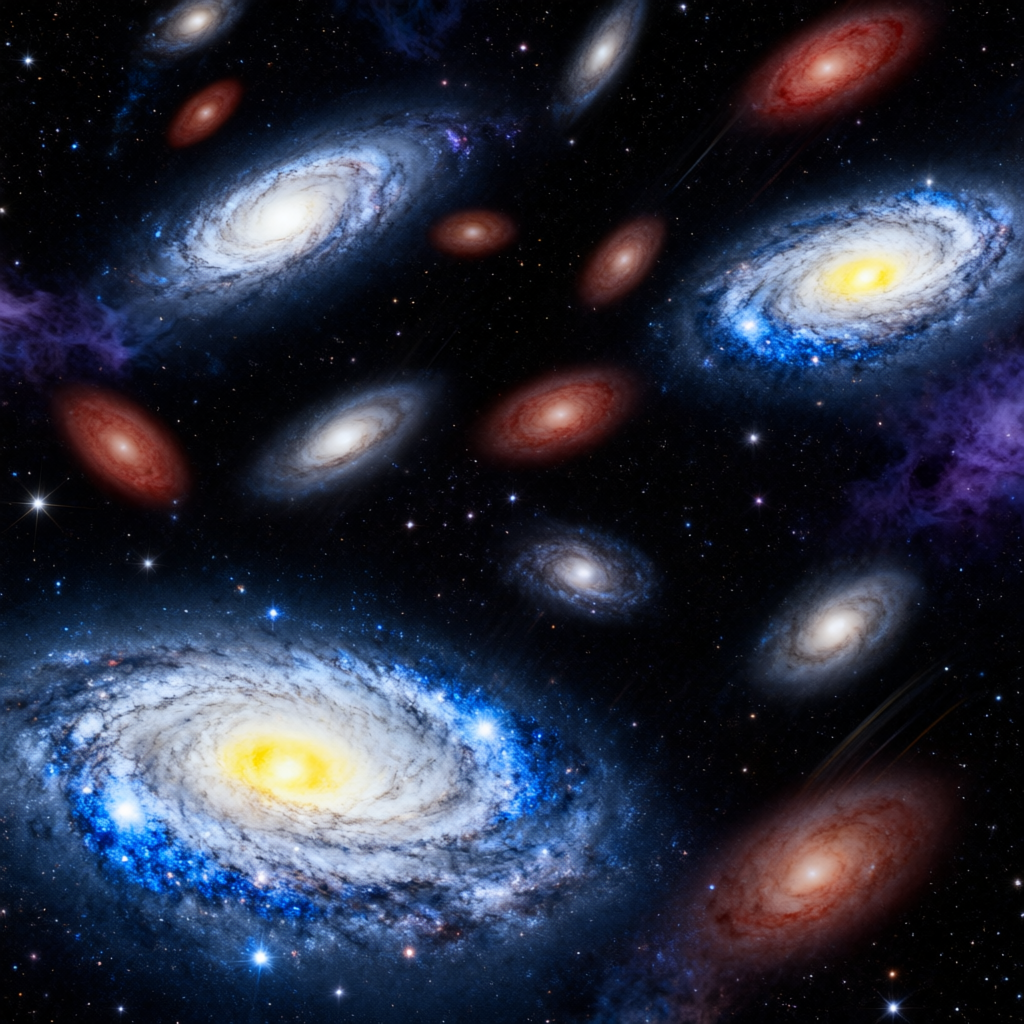
Crucially, cosmic expansion is an ongoing process. The universe is not merely vast; it is actively becoming larger. Measurements of the Hubble constant show that this expansion continues today, and in fact, recent observations suggest it is accelerating due to dark energy. This is a specific, time-dependent phenomenon, not simply a static property of having been created large.
If the Qur'an intended to describe this exact process, we would expect language that captures the continuous nature of expansion, something like 'We are continuously expanding it' or 'We cause it to expand.' The Arabic verb for such a process would likely be in the imperfect tense (e.g., 'nawassi'uha') to denote ongoing action. However, 51:47 uses a noun form, which leans toward a completed or inherent state.
None of this disproves that the verse could be read in light of modern cosmology. But it does mean that the primary linguistic evidence does not force a reading of continuous expansion. The verse is compatible with the idea that God made the heavens vast, which was also a known concept in pre-modern times (e.g., the ancient Greeks debated the size of the cosmos). Also, the claim of a miraculous prediction is weaker than often asserted, and the claim of scientific error is equally unsupported.
Resolution: Investigating the Claim of Scientific Error
Given the linguistic analysis, we can now directly address the claim of scientific error. Skeptics sometimes argue that 51:47 hedge as appears to or suggests pending a lexicon citation wrong because it says God expands the heavens, but modern physics describes expansion differently. This argument conflates two things. The literal text and a particular interpretation. The verse does not state that expansion happens continually; it states that God is the expansive One, which can be read as a reference to God's power to create a vast cosmos, not necessarily an ongoing process.
If someone insists that 'musi'un' must mean ongoing expansion, they are imposing a specific scientific model onto the Arabic. The word itself does not require that. Therefore, the charge of scientific inaccuracy depends on a prior commitment to one interpretation. Once we recognize the lexical range, we see that the verse is coherent regardless of whether one accepts modern cosmology. It would be accurate even if the universe were static and large.
On the other hand, if the verse is read as predicting modern expansion, it does not conflict with science either. It simply affirms a general truth: God is the One who makes things wide/spacious. This is not a specific prediction of the Hubble expansion, but it is not contradicted by it. The verse is compatible with both a static vast universe and an expanding one.
Also, the charge of scientific error fails because the verse does not commit to a specific mechanism or timeline. The Qur'an does not say the universe is expanding now, it says God is expansive. That is a statement about God's attribute and creative action, not a physical description that could be falsified. The investigation reveals that the text holds up under scrutiny.
Conclusion: What the Evidence Actually demonstrates
Verse 51:47 of the Qur'an is often cited in discussions of scientific accuracy. After examining the Arabic word 'musi'un', its lexical range, and the context of the verse, we find that the text describes God's act of creating the heavens with vastness and capacity. It does not explicitly describe an ongoing process of expansion in the modern cosmological sense, but it is not incompatible with such a reading.
The claim of scientific error presupposes that the verse makes a specific scientific claim that can be falsified. However, the primary meaning of the verse is theological: it affirms that God is the One who creates space and breadth. This is a statement about divine power, not a scientific hypothesis. Therefore, the charge of inaccuracy does not hold.
For those interested in the relationship between the Qur'an and science, this verse serves as a reminder to read carefully, distinguish between literal text and interpretation, and avoid imposing modern categories onto ancient language. The Qur'an itself calls for reflection, and that is what we have done. The evidence vindicates the text: it is coherent, precise in its own linguistic context, and does not contradict observable reality.
Whether you view the verse as a interesting insight or a general statement, the investigation demonstrates that the Qur'an does not contain scientific errors here. It says what it says, and that is sufficient.