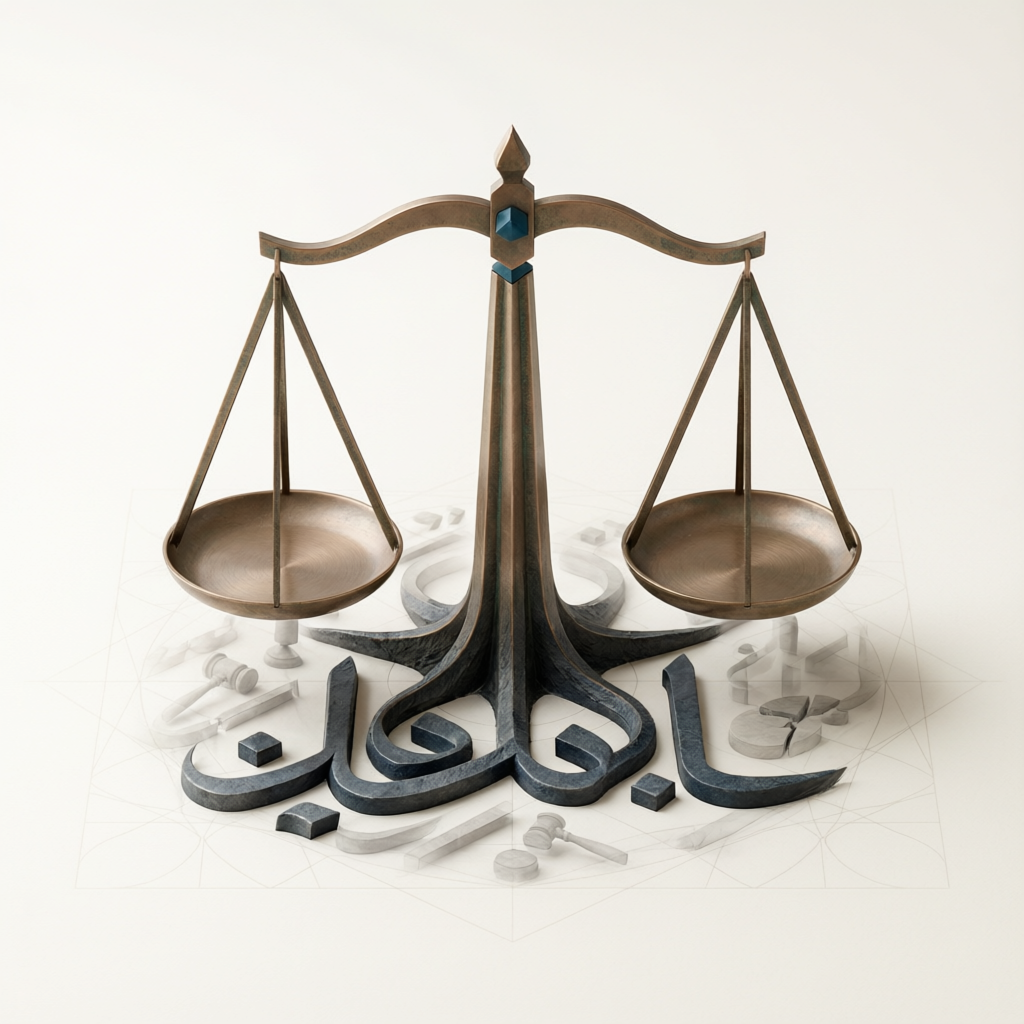
The Modern Ethical Framework: Justice as Agreement or Utility
Contemporary discussions of justice often fall into one of two camps: social contract theory or utilitarianism. Social contract theorists, following thinkers like John Rawls, argue that justice is what free and rational people would agree to under fair conditions, a set of principles that no one could reasonably reject. Utilitarians, by contrast, define justice as the arrangement that produces the greatest good for the greatest number. Both frameworks are human-centered. They derive justice from human reasoning, negotiation, or calculation of consequences.The standard is ultimately subjective, shifting with consensus or outcomes. This worldview dominates modern ethics, but it raises a crucial question. Does the Qur'an operate within this paradigm, or does it ground justice elsewhere? The answer begins with a single verse, 4. 58, and the Arabic word at its heart.
The Qur'anic Command in 4:58: Arabic and Literal Meaning
The verse in question is Qur'an 4: 58. 'Indeed, Allah commands you to render trusts to whom they are due and, when you judge between people, to judge with justice.' In Arabic, the key phrase is 'wa-idhā ḥakamtum bayna an-nāsi an taḥkumū bil-'adl' (وَإِذَا حَكَمْتُم بَيْنَ النَّاسِ أَن تَحْكُمُوا۟ بِٱلْعَدْلِ). The word 'adl (عَدْل) is the lexical anchor. Classical Arabic lexicons, such as Lisān al-'Arab, define 'adl as 'that which is straight, equitable, and just; the opposite of oppression (ẓulm).' It carries the sense of placing something in its proper place, giving each thing its due without excess or deficiency. Importantly, 'adl is not a negotiated outcome; it is an objective standard that the judge must apply. The verse does not say 'judge according to what you think best' or 'according to what people agree upon.' It says to judge with 'adl, a fixed measure that exists independently of human preference. This is the first clue that Qur'anic justice rests on a different foundation than modern ethical systems.

The Immediate Context of 4:58: Trusts and Judgment
Verse 4: 58 opens a passage that deals with trusts, judgment, and obedience to authority. The preceding verses (4. 54-57) discuss the People of the Book and their jealousy over what Allah has given, while the following verses (4. 59-63) command obedience to Allah, His Messenger, and those in authority, and warn against hypocrisy.Within this context, the command to render trusts (amānāt) to their owners comes first, followed by the command to judge with justice. The two commands are linked: trusts are to be given to their rightful owners, and judgment is to be rendered fairly between people. The verse does not provide a detailed code of what justice entails in every scenario, but it establishes a principle. The judge must adhere to 'adl. This suggests that 'adl is a knowable standard, something rooted in the nature of reality as created by Allah. Unlike social contract theories, which treat justice as a human invention, or utilitarianism, which treats it as a calculation of outcomes, the Qur'an presents justice as a divine command that aligns with objective truth. The believer is not free to redefine justice based on circumstances; they must discover and apply it.
The Semantic Range of 'Adl: More Than Fairness
To understand the depth of 'adl, we can examine its usage across the Qur'an. In 6: 152, Allah commands. 'And when you speak, be just ('ādlū), even if it concerns a relative.' In 5. 8, the command is stronger.'And do not let hatred of a people incite you not to be just (ta'dilū).Be just; that is nearer to piety.' The root indicates a perfect balance, both in scales and in judgment. In 55: 7-9, Allah describes raising the sky and establishing the balance (mīzān) 'that you not transgress in the balance. And establish weight in justice (bil-qisṭ) and do not make deficient the balance.' While qisṭ is another word for justice, the conceptual overlap is clear. Justice is alignment with a cosmic order.The semantic range of 'adl covers equity, balance, and exactness. It is not merely 'fairness' as a subjective feeling, but conformity to a standard that exists whether or not anyone agrees. This aligns perfectly with the Qur'anic worldview. Allah has created everything with truth and measure (54. 49), and human justice is meant to reflect that divine order.

How Qur'anic Justice Differs from Modern Ethical Systems
The distinction between Qur'anic justice and modern ethics is not academic; it has practical consequences. In a social contract framework, justice is provisional, dependent on the agreement of parties. If everyone agrees to an unjust law, it can technically be just according to that system. In utilitarianism, an action that harms a minority to benefit the majority can be considered just if the net happiness increases. The Qur'anic framework rejects both because justice is not defined by human consensus or outcomes. It is defined by Allah's command. For example, in 4: 135, Allah says. 'O you who have believed, be persistently standing firm in justice (qisṭ), witnesses for Allah, even if it be against yourselves, your parents, or your relatives. Whether one is rich or poor, Allah is more worthy of both.' This verse demands justice even when it harms one's own interests or those of loved ones, precisely the opposite of self-interested negotiation or majority happiness. The standard is external and objective, grounded in the Creator's knowledge of what is right.
Conclusion: The Unchanging Foundation of Justice
The investigation of 4: 58 shows that the Qur'an defines justice not as a human construct, but as a divine obligation rooted in the word 'adl. This is not a semantic quibble; it reveals a fundamentally different worldview. Modern ethics, lacking an objective anchor, must rely on ever-shifting consensus or calculation. The Qur'an, by contrast, commands believers to judge with a justice that exists independently of their opinions, a justice that aligns with the very fabric of creation. This does not mean the Qur'an provides a detailed legal code for every situation, but it establishes a principle. Justice is not what people agree on; it is what Allah commands.For those investigating honestly, this raises a profound question. If justice is objective, where does its standard come from? The Qur'an points to the Creator, and the evidence consistently supports the text. The reader is invited to examine this for themselves, starting with the Arabic of 4. 58 and the testimony of the Qur'an as a whole.