The Apparent Contradiction: Six vs. Eight Days
The Qur'an repeatedly states that Allah created the heavens and the earth in six days. In Surah 7: 54, we read. Indeed, your Lord is Allah, who created the heavens and the earth in six days. This statement appears in multiple chapters (10: 3, 11. 7, 25:59, 32:4, 50:38, 57:4). The consistency seems clear: creation took six days.
However, in Surah Fussilat (41: 9-12), a different timeline appears to be presented. Verse 9 says. Say, Do you indeed disbelieve in He who created the earth in two days? Verse 10 adds: And He placed therein firmly set mountains and measured therein its sustenance in four days. Then verse 11 describes the creation of the heavens, and verse 12 says. And He completed them as seven heavens within two days. Adding the numbers: two (earth) + four (mountains and sustenance) + two (heavens) equals eight days, not six.
This apparent discrepancy is one of the most commonly cited potential contradictions against the Qur'an. Critics argue that the text is internally inconsistent: sometimes it says six, sometimes eight. The question is whether this is a genuine contradiction or a misunderstanding of the Arabic.
Examining the Arabic: Are the Four Days Sequential or Overlapping?
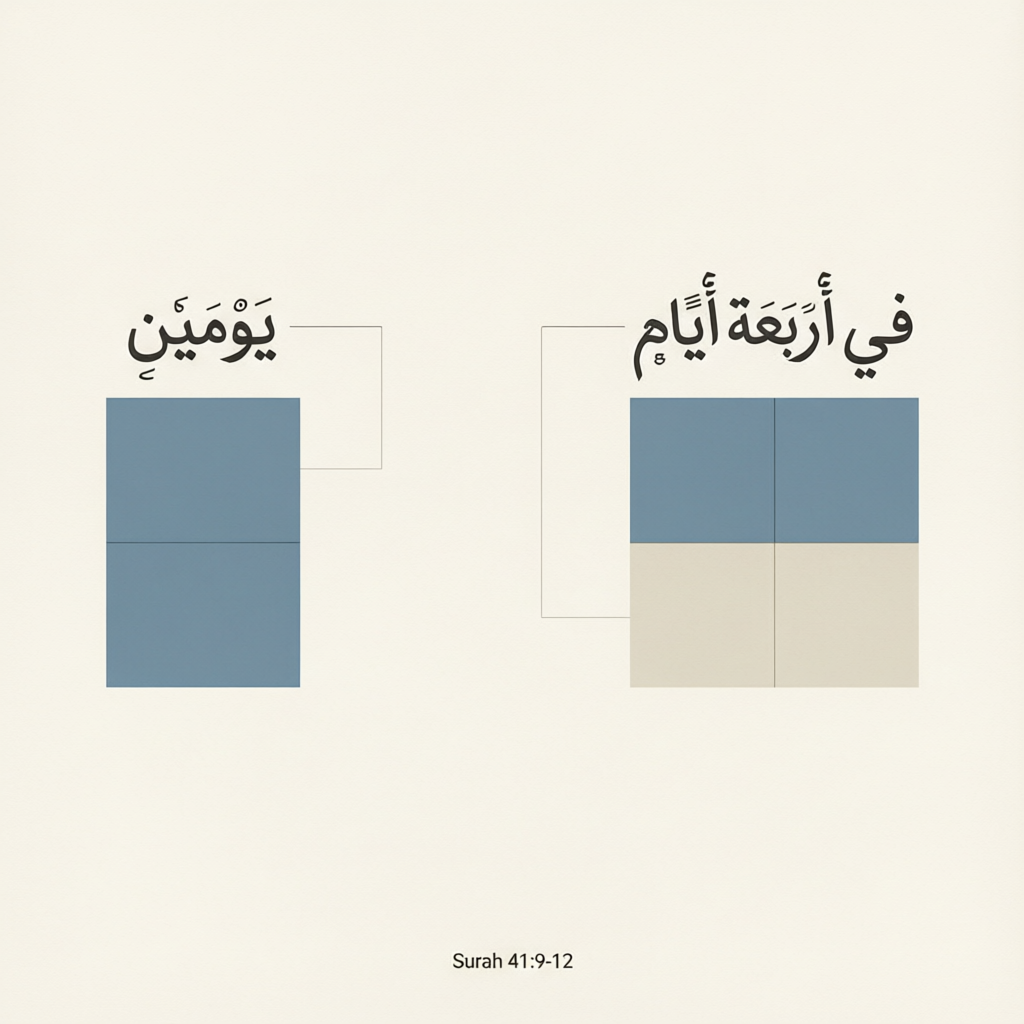
To resolve the apparent contradiction, we must look carefully at the Arabic text. In 41: 9, the word for two days is يَوْمَيْنِ (yawmayn). In 41. 10, the phrase is فِي أَرْبَعَةِ أَيَّامٍ (fī arbaati ayyām), in four days. The key question is whether these four days are consecutive to the two days of earths creation, or inclusive of them.
Arabic grammar allows for the preposition فِي (fī) to indicate that the events described in verse 10 (placing mountains and measuring sustenance) occurred within the same period as the earth’s creation, not after it. This interpretation is supported by classical Arabic usage and by many Qur'anic commentators. In other words, the two days for the earth and the four days for the details may overlap, not add.
If the four days are inclusive of the two days, then the total time for earth-related creation remains two days, not six. That would mean the timeline is: two days for the earth (including placing mountains and sustenance) + two days for the heavens = four days. But the Qur'an says six days, so there is still a gap of two days. However, the four days for earth could be inclusive of the two, making it two + two = four, but the total in 7. 54 is six. The resolution lies in a third element.
The Missing Two Days: A Third Phase of Creation
Many classical and modern commentators note that 41: 9-12 does not mention the creation of the earth and heavens themselves, but rather specific stages. Verse 9 says created the earth, but the earth’s matter may have been created earlier. Creation in the Qur'an often involves a prior stage. The heavens and the earth were initially a single mass (21. 30), then separated. That process is not included in the six days.
When we look at 41:9-12, the two days for the earth are for its creation (making it a distinct entity), the four days are for its features (mountains, sustenance), and the two days for the heavens are for their formation as seven heavens. However, the total of these events does not account for the entire six-day creation. Where are the other two days?
The answer is found by examining the full creation narrative. In 7: 54, the six days include the creation of the heavens and the earth and all that is between them. The six days encompass a broader scope than just the events in 41. 9-12.In 41: 9-12, Allah is recounting specific details to illustrate His power, not giving a complete sequential timeline. The two missing days may refer to the creation of what lies between the heavens and the earth, such as the sun, moon, and stars, or to the initial stage of the universe (the smoke of 41. 11 before formation). Since the Qur'an does not provide an exhaustive minute-by-minute account, the numbers align when we recognize that 41:9-12 is a partial description, not the full schedule.
Lexical and Contextual Resolution: Understanding ‘Day’ in the Qur'an
Another key to resolving the apparent contradiction is understanding the Arabic word يَوْم (yawm), often translated as day. In the Qur'an, yawm does not always refer to a 24-hour period; it can signify a period of time, a stage, or an epoch. For example, 22: 47 says. And indeed, a day with your Lord is like a thousand years of what you count. Similarly, 70:4 describes a day that is fifty thousand years long. Also, the six days of creation are six distinct phases or periods, not necessarily consecutive 24-hour days.
When 41:9-12 mentions two days, four days, and two days, these are also phases, likely overlapping or sequential in a broader scheme. The four days in verse 10 are explicitly qualified as encompassing the creation of the earth’s features, but they do not necessarily add to the two days of earth-creation; rather, they are a detailed elaboration of what happened during that time. This is similar to saying I built a house in two months, and I painted it in those same two months; the total remains two months, not four.
Therefore, the chronological reading is: the earth was created in two days; during those two days, its features (mountains, sustenance) were arranged; then the heavens were formed in two days; and other creation (such as the establishment of the throne, the creation of angels, etc.) occupied the remaining two days mentioned elsewhere. The Qur'an itself does not itemize every event of each day, so missing details do not constitute contradiction.
Conclusion: The Qur'an Speaks with One Voice on Creation
After examining the Arabic text, grammar, and context, the claim of a contradiction between the six days of 7: 54 and the eight days seemingly implied by 41. 9-12 dissolves. The four days of verse 10 are not additional to the two days of verse 9; they are a subset. The two days of verse 12 for the heavens are separate. Also, the timeline presented in 41:9-12 is two days for earth (inclusive of its features) plus two days for the heavens, totaling four days, but this account is not exhaustive; it omits the creation of other elements that occupy the remaining two days of the six.
This conclusion is supported by the consistent use of the number six across multiple surahs, all emphasizing that creation took six days. The Qur'an does not contradict itself; rather, the apparent discrepancy arises from reading English translations without considering Arabic grammar and the partial nature of the description in Fussilat.
For the researcher or skeptic, this investigation demonstrates the importance of going to the primary source, the Arabic Qur'an, and analyzing it according to its own linguistic rules. When that is done, the text proves internally coherent. The Qur'an's claim about creation is not self-contradictory; it is a consistent, layered narrative that rewards careful study.