The Verse Itself: Arabic, Transliteration, and Literal Meaning
The investigation has to begin with the wording itself, not with what anyone — critic or apologist — has said about it. The relevant clause of Qur'an 57:25 reads:
وَأَنزَلْنَا الْحَدِيدَ فِيهِ بَأْسٌ شَدِيدٌ وَمَنَافِعُ لِلنَّاسِ

Transliteration: wa anzalnā al-ḥadīda fīhi ba'sun shadīdun wa manāfiʿu lil-nās.
Word by word: wa (and) — anzalnā (We sent down / We caused to descend — from the root ن-ز-ل, n-z-l) — al-ḥadīd (the iron) — fīhi (in it) — ba'sun (might, force, severity) — shadīd (great, intense) — wa manāfiʿu (and benefits) — lil-nās (for the people).
The literal, surface-level rendering is straightforward: 'And We sent down iron, in which is great might and benefits for people.' The investigative question this raises is equally straightforward: does anzalnā, applied to a metal, assert that iron physically fell from the sky onto the earth, or does the root n-z-l carry a broader sense that this specific use is drawing on? That question cannot be answered by intuition or by translation alone. It has to be answered by checking how the Qur'an itself uses this root elsewhere — which is the next step, and the only way to avoid assigning a meaning to an Arabic word without lexical evidence.
Testing the Root ن-ز-ل Across the Qur'an
If anzalnā always meant strict, physical, sky-to-ground descent, that would be discoverable by checking its other occurrences. Two cases make the test clear.
Qur'an 39:6 states: وَأَنزَلَ لَكُم مِّنَ الْأَنْعَامِ ثَمَانِيَةَ أَزْوَاجٍ — 'And He sent down for you eight pairs of grazing livestock.' Livestock are born and raised through ordinary biological reproduction, not precipitated from the sky. The verb anzala is applied here to something provided and made available to people, not something that literally descended through the air.
Qur'an 7:26 states: قَدْ أَنزَلْنَا عَلَيْكُمْ لِبَاسًا يُوَارِي سَوْآتِكُمْ — 'We have sent down to you clothing to cover your private parts.' Clothing is manufactured by human hands from fiber and hide. Again, anzalnā describes something bestowed or made available, not something that fell from above.
Against these, the Qur'an also uses the same root for cases of genuinely literal descent: rain (e.g., 'and We sent down from the sky water,' as in 25:48 and elsewhere), and revelation itself (anzalnā al-Qur'ān, 'We sent down the Qur'an,' 97:1). So the root n-z-l is demonstrably used in the Qur'an in at least two distinct senses: a literal-descent sense (rain, revelation) and a provision/bestowal sense (livestock, clothing). This is not an inference from outside the text — it is shown directly by comparing verses within it, which is the standard the investigation requires before any conclusion about 57:25 can be drawn.
Two Readings of 57:25, Held Side by Side
With both senses of the root established from the text itself, two readings of 'We sent down iron' become lexically available, and neither can be dismissed by assertion.
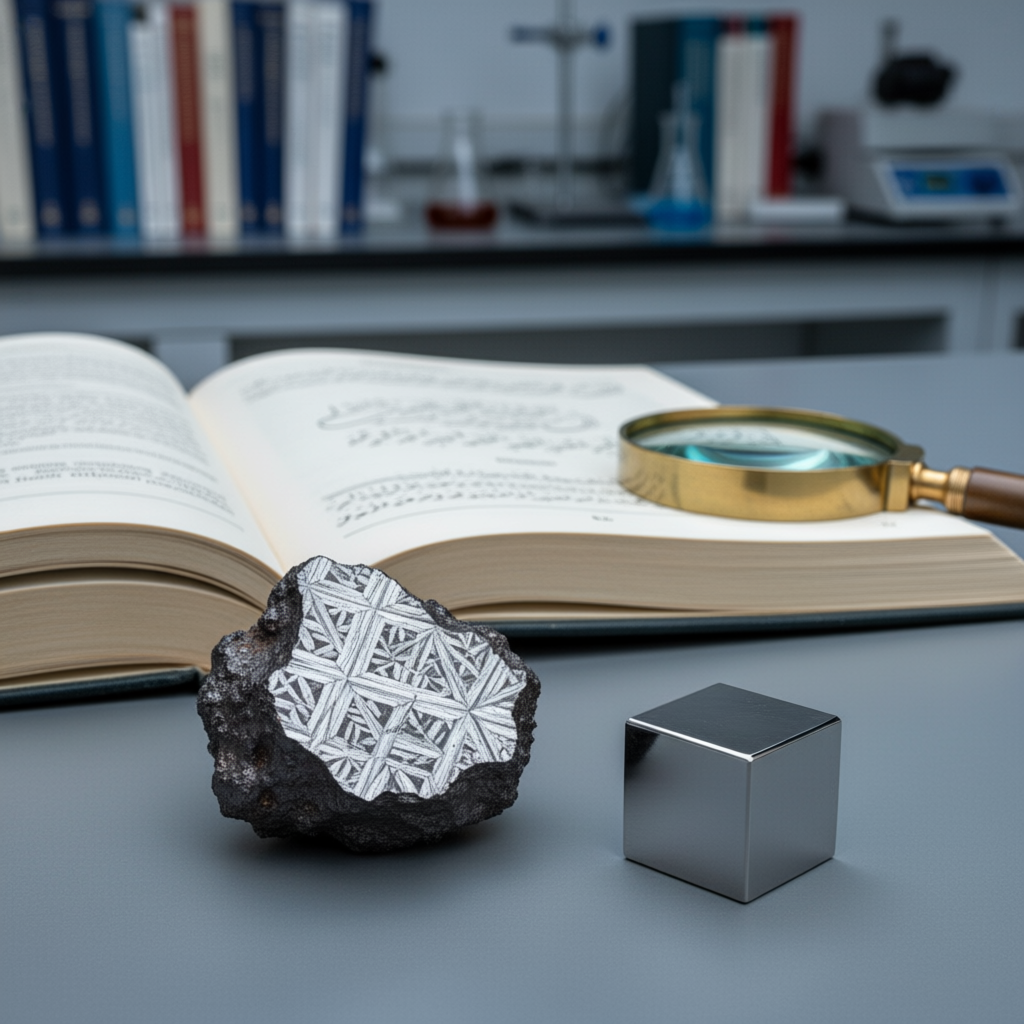
The first reading treats anzalnā al-ḥadīd the way 39:6 and 7:26 treat livestock and clothing: as a statement of provision. On this reading, the verse is saying that iron — like livestock and clothing — was made available to humanity as a resource, without the verb making any claim about iron's physical trajectory through space. The surrounding clause supports this framing, since it immediately pivots to iron's usefulness: 'in which is great might and benefits for people' — a statement about function and value, not about origin or trajectory.
The second reading takes the literal-descent sense seriously, on the grounds that the Qur'an does use anzala literally for physical things that come from above (rain, and by extension, matter that originates beyond the earth). On this reading, the choice of anzalnā specifically for a metal — as opposed to a verb used for growing, mining, or forming — is at minimum a striking word choice worth investigating further, even if the text itself does not elaborate on the mechanism.
Both readings are grammatically and lexically permissible given what the root does elsewhere in the Qur'an. Neither is ruled out by the Arabic alone. Declaring one the 'true' reading at this stage, before bringing in any further evidence, would be asserting a conclusion the text hasn't yet settled — which the investigation must avoid.
The Separate Question: Where Does Iron Actually Come From?
A distinct and independent line of evidence exists outside the Qur'an entirely: the astrophysical account of where iron comes from. This is secondary evidence, and it must be evaluated on its own terms, not read backward into the Arabic to settle the lexical question above.
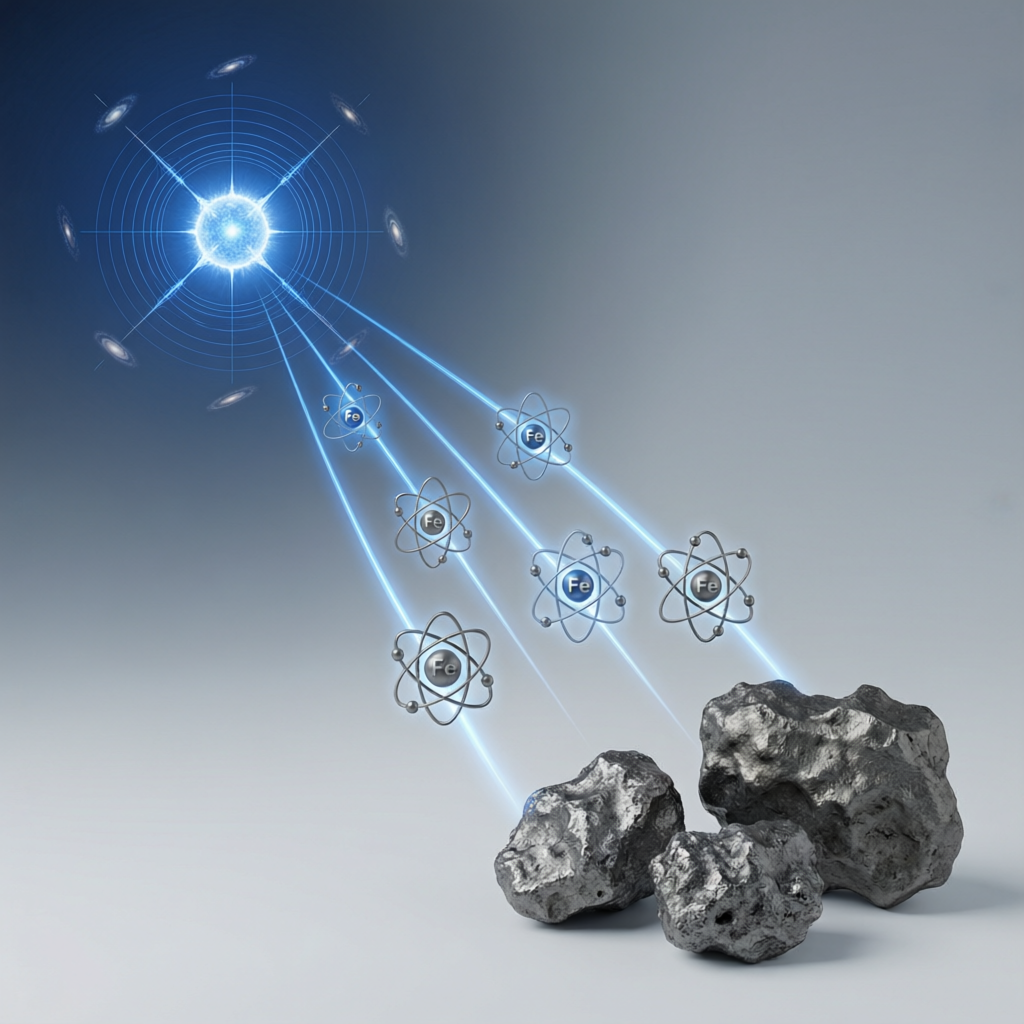
Modern astrophysics holds that iron is produced through nuclear fusion inside the cores of massive stars, and that elements at or beyond iron's mass are dispersed into space primarily through supernova explosions, later becoming part of the material from which planets — including the early Earth — formed. Unlike lighter elements such as carbon or oxygen, which stars can produce throughout much of their lives, iron sits at a specific point in the fusion chain where energy is no longer released but consumed, which is part of why iron formation is closely tied to a star's late-stage collapse. This is a well-established position within contemporary astrophysics, and readers investigating it further should consult primary astrophysics literature and stellar nucleosynthesis references directly rather than taking any single restatement — including this one — as the final word.
The important discipline here is separation: this scientific account does not, by itself, tell us what the Arabic word anzalnā means in 57:25. Similarity between 'iron came from beyond Earth' and 'We sent down iron' is not, on its own, proof that the verse is describing nucleosynthesis. Treating a modern scientific finding as automatic 'confirmation' of a specific translation is the same evidentiary error as assuming borrowing from mere similarity — it skips the step of demonstrating the connection and simply asserts it.
Synthesis: What the Evidence Supports and What It Doesn't
Bringing the lexical and scientific tracks back together, without merging them, produces a measured conclusion.
What is well-supported: the wording of 57:25 is not linguistically strained or anomalous. The root n-z-l is demonstrably used elsewhere in the Qur'an — for livestock in 39:6, for clothing in 7:26 — in a provision/bestowal sense applied to things that are not literally precipitated from the sky. Applying that same root to iron is therefore consistent with an established pattern in the text's own usage, not a translation stretch invented to dodge a problem. This directly answers a common objection: the claim that anzalnā 'must' mean literal sky-fall, and that applying it to a mined metal is therefore a contradiction, does not hold up once the root's documented range is checked against the text itself.
What remains open: the verse does not spell out stellar fusion, supernovae, or any mechanism. Asserting that 57:25 is a scientific description of nucleosynthesis goes beyond what the lexical evidence in this verse establishes, and would require the same standard of proof as any other extraordinary claim — proportionally strong, explicit evidence, which has not been demonstrated here. The honest position is that the wording is compatible with the modern finding about iron's origin without being proof of it, and it is also fully coherent under a plain provision reading that makes no claim about physical descent at all. Both of those things can be true together, and stating that plainly is more faithful to the evidence than forcing the verse into either an apologetic or a skeptical box.
How to Check This Yourself
None of the above should be taken on trust — the entire point of this method is that it is reproducible.
Start with a verified Arabic Qur'an text and a root-based concordance or search tool. Search for the root ن-ز-ل (n-z-l) and read through its occurrences in context — not just the ones cited here, but the fuller set, including its uses for rain, revelation, provision, and other objects. Note which uses are unambiguous literal descent and which are not, and check whether the immediate context of each verse supports your reading.
Then return to 57:25 and read it in full, not just the iron clause. The verse opens by describing messengers sent with clear proofs, the Book, and 'the balance,' so that people may establish justice — and the mention of iron sits inside a passage about justice, strength, and human benefit, with the phrase 'that Allah may know who supports Him and His messengers unseen' following shortly after. Reading the iron clause inside that fuller context matters before drawing any theological or scientific conclusion from three words in isolation.
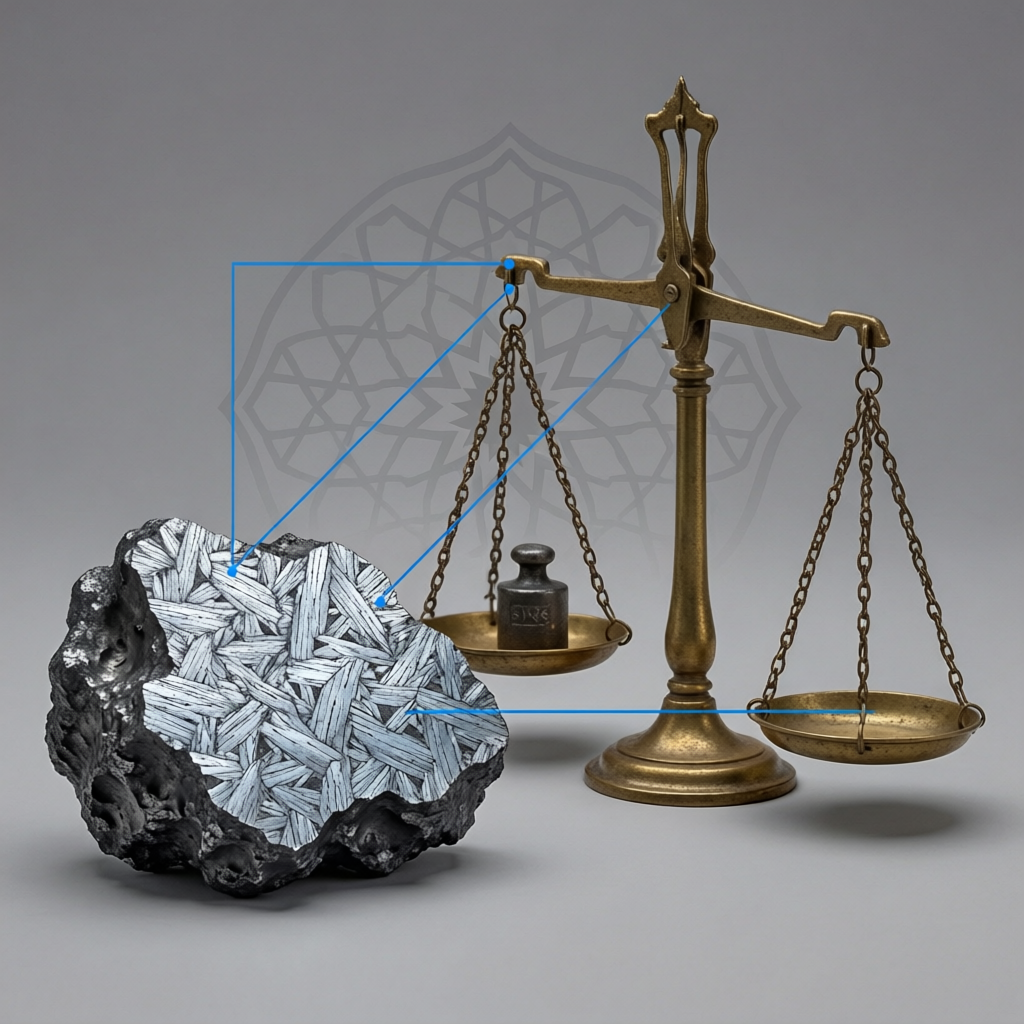
This is the discipline the investigation asks of the reader throughout: retrieve the text rather than relying on memory or secondhand paraphrase, separate the literal wording from interpretation, keep textual and scientific evidence in their own lanes, and only draw a conclusion as strong as the evidence actually demonstrates.