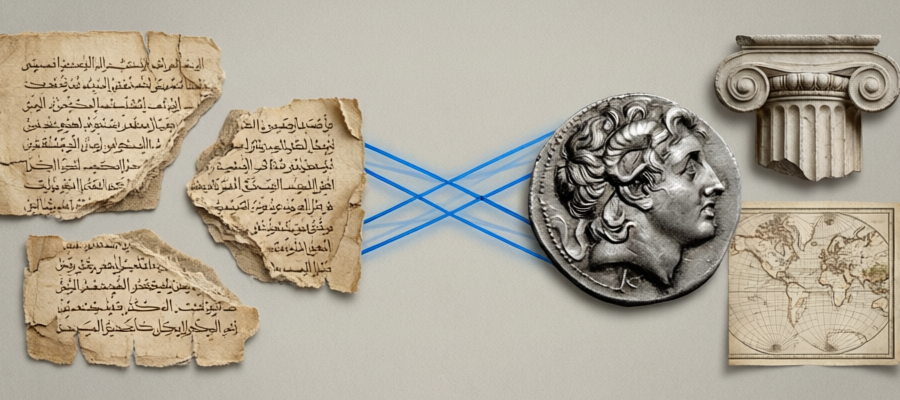
The Account Itself: Qur'an 18:83-98 in Arabic and Translation
Surah al-Kahf introduces the figure of Dhul-Qarnayn as an answer to a question put to Muhammad. Verse 83 reads: وَيَسْأَلُونَكَ عَنْ ذِي الْقَرْنَيْنِ قُلْ سَأَتْلُو عَلَيْكُم مِّنْهُ ذِكْرًا — "And they ask you about Dhul-Qarnayn. Say, 'I will recite to you a report about him.'" The frame is deliberate: the text presents what follows as a recitation being given in response to an inquiry, not as an independent biography inserted for its own sake. Verse 84 immediately establishes the figure's position: إِنَّا مَكَّنَّا لَهُ فِي الْأَرْضِ وَآتَيْنَاهُ مِن كُلِّ شَيْءٍ سَبَبًا — "Indeed, We established him upon the earth, and We gave him a means to everything." The word sabab (سَبَب) carries the sense of a rope, a means of attainment, or an instrument by which one reaches a goal — its ordinary lexical range in classical Arabic usage, attested across the Qur'an's own repeated use of the term in this same passage (18:84, 18:85, 18:89, 18:92).
The narrative then moves in stages, each introduced by the same formula, فَأَتْبَعَ سَبَبًا — "so he followed a means." At 18:86: حَتَّىٰ إِذَا بَلَغَ مَغْرِبَ الشَّمْسِ وَجَدَهَا تَغْرُبُ فِي عَيْنٍ حَمِئَةٍ وَوَجَدَ عِندَهَا قَوْمًا — "Until, when he reached the setting of the sun, he found it setting in a spring of dark mud, and he found near it a people." God's instruction to him follows immediately: قُلْنَا يَا ذَا الْقَرْنَيْنِ إِمَّا أَن تُعَذِّبَ وَإِمَّا أَن تَتَّخِذَ فِيهِمْ حُسْنًا — "We said, 'O Dhul-Qarnayn, either you punish them or else adopt among them a way of goodness.'" Verses 87-88 attach moral commentary directly to this encounter: whoever does wrong will be punished and then returned to his Lord for a severe reckoning, but whoever believes and does righteousness will have the best reward, and will be spoken to with ease.
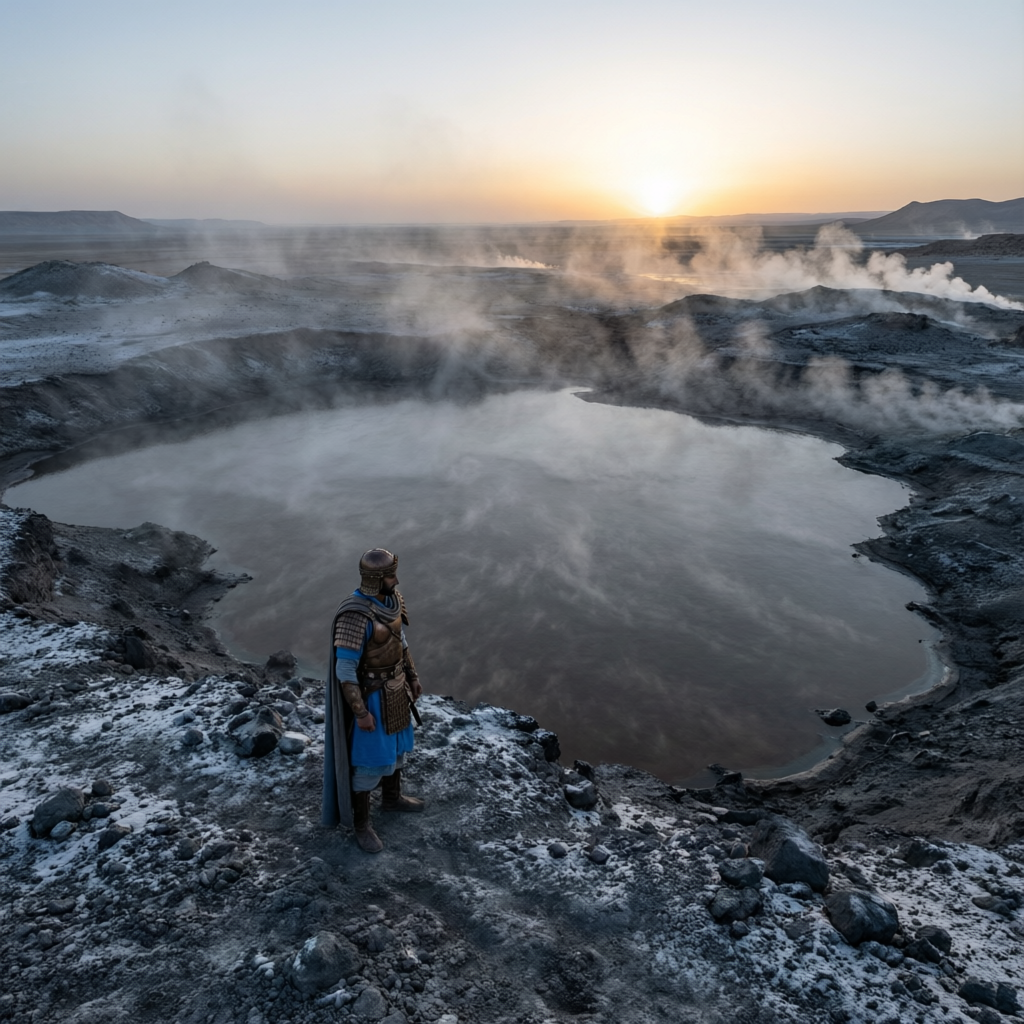
At 18:90, the second stage: حَتَّىٰ إِذَا بَلَغَ مَطْلِعَ الشَّمْسِ وَجَدَهَا تَطْلُعُ عَلَىٰ قَوْمٍ لَّمْ نَجْعَل لَّهُم مِّن دُونِهَا سِتْرًا — "Until, when he reached the rising of the sun, he found it rising on a people for whom We had not made any shelter against it." The third stage, at 18:93, brings him بَيْنَ السَّدَّيْنِ — "between two mountain barriers," where he meets a people who can barely understand speech. They ask him, at 18:94, to build a barrier against يَأْجُوجَ وَمَأْجُوجَ — Gog and Magog — described as مُفْسِدُونَ فِي الْأَرْضِ, corrupters in the land.
Dhul-Qarnayn's reply and the construction itself follow at 18:95-97: he declines payment, asks instead for manual assistance, and directs the building of a barrier from زُبَرَ الْحَدِيدِ (pieces of iron) sealed with قِطْرًا (molten copper), until Gog and Magog فَمَا اسْطَاعُوا أَن يَظْهَرُوهُ وَمَا اسْتَطَاعُوا لَهُ نَقْبًا — "were unable to climb over it, nor were they able to bore through it." The account closes at 18:98 with Dhul-Qarnayn attributing the result to God: هَٰذَا رَحْمَةٌ مِّن رَّبِّي — "This is a mercy from my Lord" — and stating that the barrier will stand only until God's promise comes, at which point it will be leveled. That is the full text under investigation, presented before any comparison is drawn.
The Syriac Alexander Legend and the Points of Contact
The comparison text most relevant to this passage is a Syriac composition scholars call the Neṣḥānā ḏ-Aleksandrōs, commonly translated as the Alexander Legend or the Syriac Alexander Legend. G. J. Reinink's philological work on the text places its composition around 629-630 CE, in the immediate aftermath of Emperor Heraclius's victory over the Sasanian Persians — a dating widely cited in subsequent scholarship, including Kevin van Bladel's 2007 study "The Alexander Legend in the Qur'an 18:83-102," which argues for a literary relationship between the two texts. The Legend itself draws on a much older tradition, the Greek Alexander Romance attributed to Pseudo-Callisthenes, a body of legendary material about Alexander the Great that had circulated in the Near East since at least the third century CE and had already been translated and adapted into multiple regional languages by late antiquity.
The points of contact between the Legend and Qur'an 18:83-98 are specific and worth stating plainly rather than gesturing at loosely. In the Syriac Legend, Alexander travels to the place where the sun sets into a foul-smelling sea and encounters peoples there; he later travels to the place where the sun rises. Both texts, in other words, structure their journey around the same two poles — the setting and the rising of the sun — and both attach an encounter with a people to each pole. This is a structural similarity, not simply a thematic one: the sequence west-then-east, each stop marked by a distinct population, appears in both accounts in the same order.
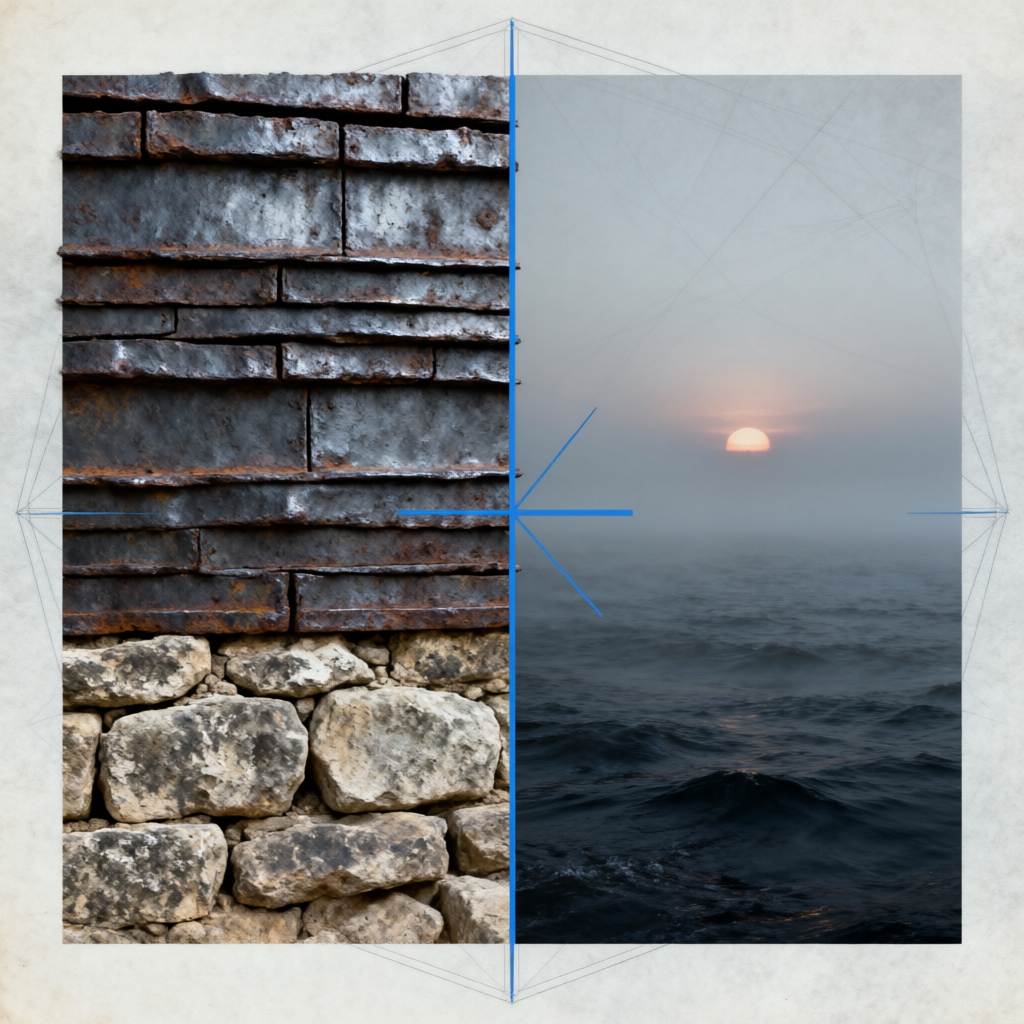
The most specific parallel concerns Gog and Magog. In the Syriac Legend, Alexander is asked to seal off the peoples identified with Gog and Magog behind a barrier, which he constructs from iron and bronze, and the text states that the barrier will hold until the end of days. The Qur'an's account at 18:94-98 shares this same core sequence: a request from a threatened population, construction of a barrier using metal, and a closing note that the barrier's endurance is bound to a future divine timeline rather than to purely human engineering. These are not vague resemblances — they are matching narrative beats occurring in the same relative position in both texts, and any honest investigation has to register that fact before moving to explanation.
It is also worth noting what family of literature both texts belong to. Gog and Magog as corrupting nations sealed away until an eschatological rupture is not an invention of either the Qur'an or the Syriac Legend — the motif has roots stretching back to Ezekiel 38-39 and reappears in Second Temple and early Christian apocalyptic writing, including Revelation 20. The Alexander Legend and the Qur'an are therefore both drawing, at minimum, on a shared reservoir of Gog-and-Magog material that predates both of them by centuries, even before the question of a direct relationship between the two texts themselves is addressed.
Where the Two Accounts Diverge
The differences between the two texts are as specific as the similarities, and the Comparative Religion Rules this investigation follows require that they be given equal weight rather than treated as footnotes to the resemblance. The first and most basic difference is that the Qur'an never names its subject Alexander. The figure is called Dhul-Qarnayn — literally "the one with two horns" or "the two-horned one" — a title, not a name, and the text offers no genealogy, no reference to Philip of Macedon, no Greek or Roman setting. The Syriac Legend, by contrast, is explicit and detailed about Alexander's identity, his lineage, and his historical context; it is, among other things, a text of political theology written to align Alexander's legendary conquests with Heraclius's real ones.
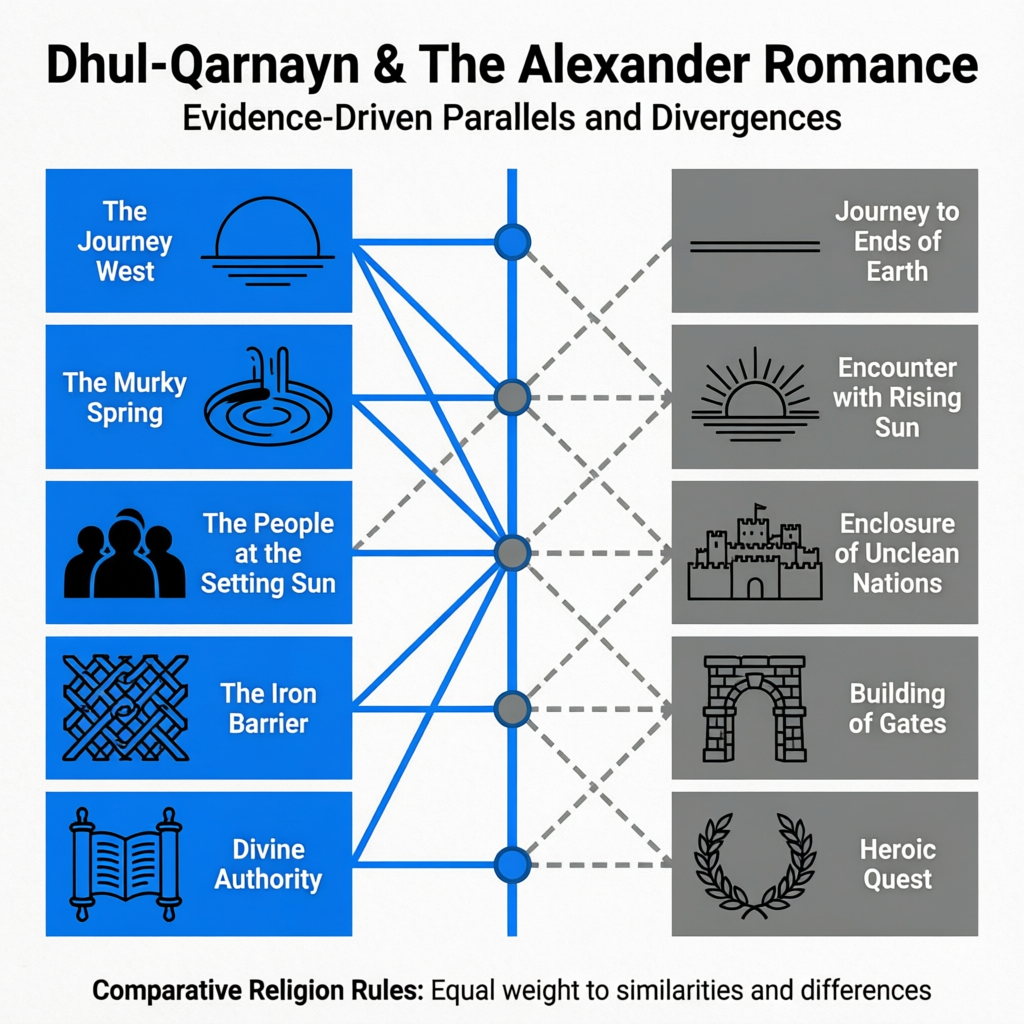
The second difference is one of framing, and it runs through the entire passage. Qur'an 18:84 describes Dhul-Qarnayn as a recipient: إِنَّا مَكَّنَّا لَهُ فِي الْأَرْضِ, "We established him upon the earth." The verb is passive in effect — he is placed, granted, given sabab — rather than being the acting subject of conquest in his own right. The Syriac Legend's Alexander, by contrast, is presented as an actor whose deeds establish his own glory and that of his empire; the text functions in part as propaganda for a living political order. The Qur'an's Dhul-Qarnayn never speaks of his own greatness. His one recorded reflection on his success, at 18:95, is to say that what his Lord has established him with is better than what people would pay him, and his final statement, at 18:98, credits the whole outcome to رَحْمَةٌ مِّن رَّبِّي — "a mercy from my Lord."
The third difference is the moral commentary embedded directly inside the narrative at 18:87-88, which has no real counterpart in the Syriac Legend's telling of the Gog and Magog episode. When Dhul-Qarnayn reaches the people at the place where the sun sets, the text does not simply record an encounter — it records a theological instruction about how wrongdoers and believers will each be met, framed as a general principle rather than an event specific to that people. The Legend's Alexander episodes are organized around political and military accomplishment; the Qur'an's account is organized, at each stage, around accountability before God. This is a difference in what the story is for, not merely in what happens in it.
A fourth difference concerns scale and detail. The Syriac Legend is expansive — it includes Alexander's correspondence, his search for immortality, extended geographic and ethnographic description, and material clearly tied to seventh-century Byzantine political concerns. The Qur'an's account, across sixteen verses, is compact and formulaic, built on a repeated refrain ("then he followed a means") rather than sustained narrative elaboration. A shorter, structurally repetitive account and a longer, digressive one sharing a skeleton is a different kind of relationship than two texts sharing extended, matching prose — and that distinction matters for what comes next.
Three Hypotheses, and What Would Prove Each
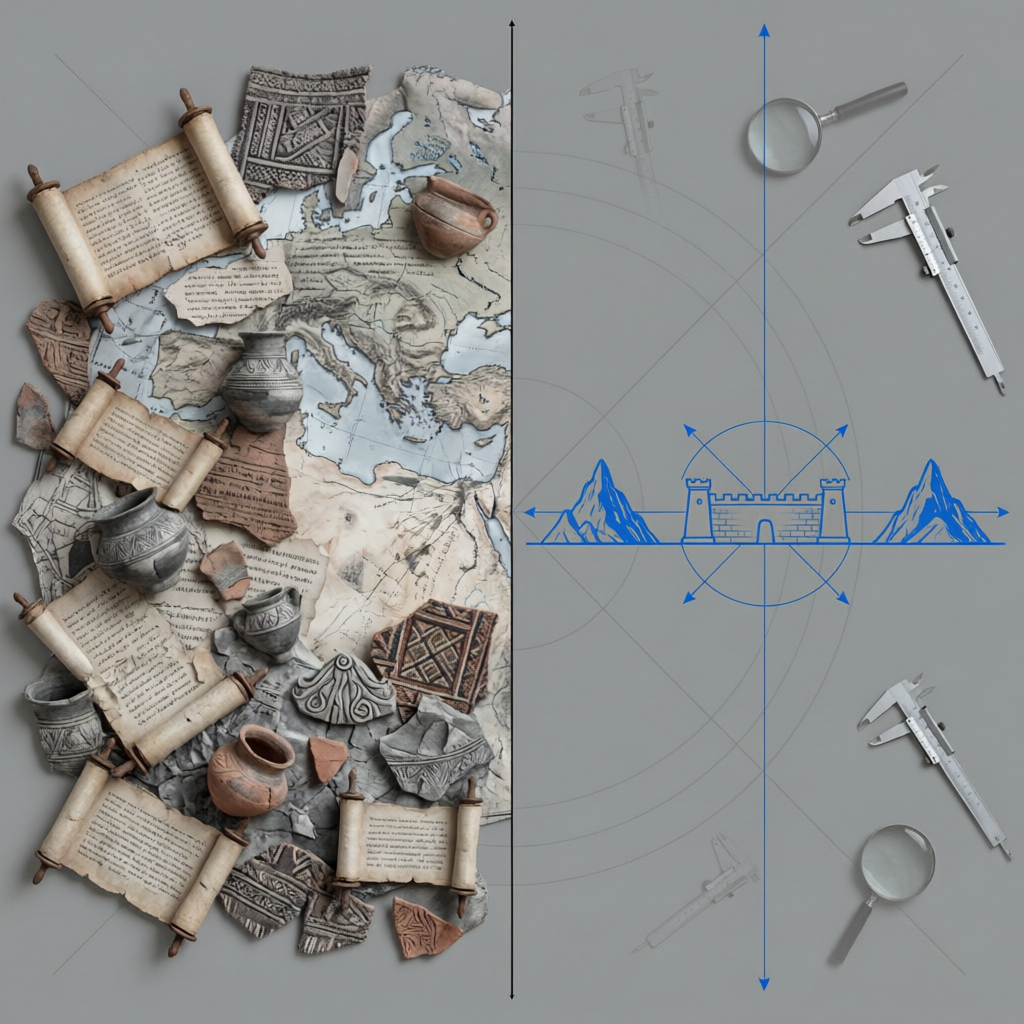
With the similarities and differences both laid out, three explanations are available, and none should be treated as the default simply because it is the one most often repeated. The first is direct literary dependence — that the Qur'an's account draws specifically on the Syriac Alexander Legend or a closely related written text. Establishing this hypothesis would require more than shared motifs: it would require verbal correspondence beyond generic storytelling elements, a demonstrable route by which a Syriac Christian text reached a seventh-century Hijazi audience, and an explanation for why the Qur'an's version diverges so consistently in name, framing, and moral content if it were copying rather than independently narrating.
The second hypothesis is a common source: both the Syriac Legend and the Qur'an drawing on a wider legend cycle about a great king who travels to the ends of the earth and contains Gog and Magog, circulating orally or in multiple textual forms across the late antique Near East before either text was fixed. Given that Gog and Magog material long predates both the Qur'an and the Syriac Legend, and that Alexander legends were already circulating in Greek, Syriac, and other regional languages for centuries by the seventh century, this hypothesis has a real evidentiary foothold. Establishing it more firmly would require identifying earlier attestations of the specific west-then-east, barrier-against-Gog-and-Magog sequence independent of the Syriac Legend's own wording.
The third hypothesis is independent narration of a widely known regional story — a Meccan audience aware of the general shape of Alexander legends, without either text being a direct source for the other. This is not a claim that the stories arose from nothing; it is a claim that shared cultural knowledge, rather than textual copying, accounts for the overlap. Distinguishing this from the common-source hypothesis is difficult in practice, since both predict overlapping motifs without direct textual dependence, and the evidence needed to separate them precisely is not currently decisive in either direction — which is worth stating plainly rather than papering over.
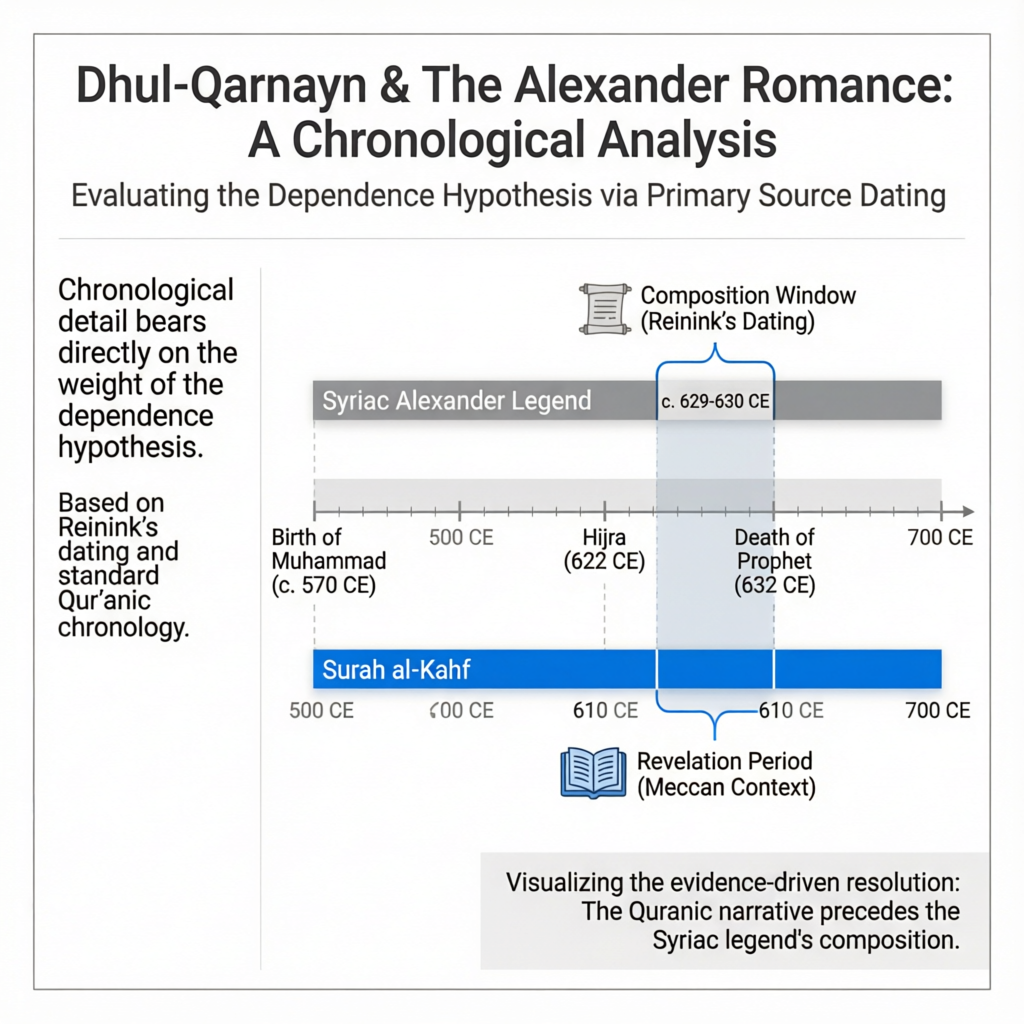
A chronological detail bears directly on how much weight the dependence hypothesis can carry. Reinink's dating places the Syriac Alexander Legend's composition at approximately 629-630 CE. Surah al-Kahf, however, is classified within the Islamic tradition as a Meccan surah, meaning its traditional dating places it well before the emigration to Medina in 622 CE — years before the Syriac Legend's proposed date of composition. This is reinforced by the oldest Qur'an manuscript evidence available for study: radiocarbon analysis of early Qur'an folios, including material in the Birmingham and Paris collections and the lower text of the Sana'a palimpsest, has placed portions of the Qur'anic text within the early-to-mid seventh century, consistent with a text already in circulation before or very close to the period the Syriac Legend was composed. A simple dependence hypothesis has to account for this timing gap; van Bladel's own response is to argue for an earlier core within the Legend's tradition that predates its final Syriac redaction, which is a reasonable scholarly move but one that itself requires further evidence rather than being assumed. Chronological priority alone does not settle the question in either direction — but it is a fact any reader weighing the three hypotheses needs in front of them, not a detail left out of the account.
Investigating Further: Why the Comparative Method Matters
None of this is presented to settle the matter by assertion. The purpose of laying out the Arabic, the translation, the specific points of contact, and the specific points of divergence side by side is so that a reader can do the same comparative work directly, rather than accepting a summary of it secondhand. That means reading 18:83-98 in full, reading the relevant portions of the Syriac Alexander Legend in translation, and checking whether the correspondences are as exact as the dependence hypothesis requires, or whether the divergences in name, framing, and moral content fit more comfortably with a shared-legend or independent-narration explanation.
This same method — similarity is not proof of dependence, difference is evidence too, and both must be weighed before a hypothesis is chosen — applies well beyond this one passage. It is the same method needed to investigate quran vs bible differences explained honestly, or to work through a quran vs torah comparison on shared figures like Moses or shared motifs like the flood. Readers who ask which is better quran or bible, or what is the main difference between quran and bible, are often really asking a comparative-literature question dressed as a theological one — and the honest answer starts the same way this article did: with the primary texts open, side by side, before any conclusion is drawn.
Doing that work requires having the primary source in hand rather than relying on paraphrase. Anyone investigating passages like Dhul-Qarnayn's account benefits from being able to check the Arabic against the English directly rather than trusting a secondhand rendering, which is a strong argument for readers who buy quran with english translation and arabic text printed together, so the literal wording and its translation can be checked line by line as this article has done. The conclusion is not that comparative religion is unimportant, or that similarities should be explained away — it is that the explanation with the fewest unsupported assumptions should be preferred, and that preference can only be reached after the evidence, not before it.
What the evidence shows, taken together, is a real structural resemblance between Qur'an 18:83-98 and the wider Alexander legend tradition, alongside real and consistent differences in naming, agency, and theological framing, set against a chronology that complicates rather than confirms a simple borrowing account. That is not a dismissal of the comparison — it is an invitation to examine it fully. The verses are cited above; the Syriac Legend and its proposed dating are cited above; the manuscript evidence for the Qur'an's early textual footprint is cited above. What remains is for each reader to weigh them against the three hypotheses and decide, on the evidence, which one the text actually supports.